
Key Takeaways
- Construction site security lighting is temporary light aimed at gates, laydown, fuel, and fence lines after the crew leaves.
- Task light follows the pour. Security light stays on the stuff that gets stolen.
- OSHA still wants foot-candles after dark. General work areas sit at 5. Storage and access ways sit at 3.
- Iron left overnight near a highway or active area needs lights, reflectors, or lighted barricades.
- OSHA’s own checklist asks if outside and parking areas are bright enough to see clearly.
- On a remote Texas pad, a dead tower at 2 a.m. is an open gate.
Construction site security lighting is temporary outdoor light pointed at gates, laydown yards, fuel pads, and fence lines so a remote site stays visible after shift. No permanent poles. No streetlights. Just LED light towers left running through the night.
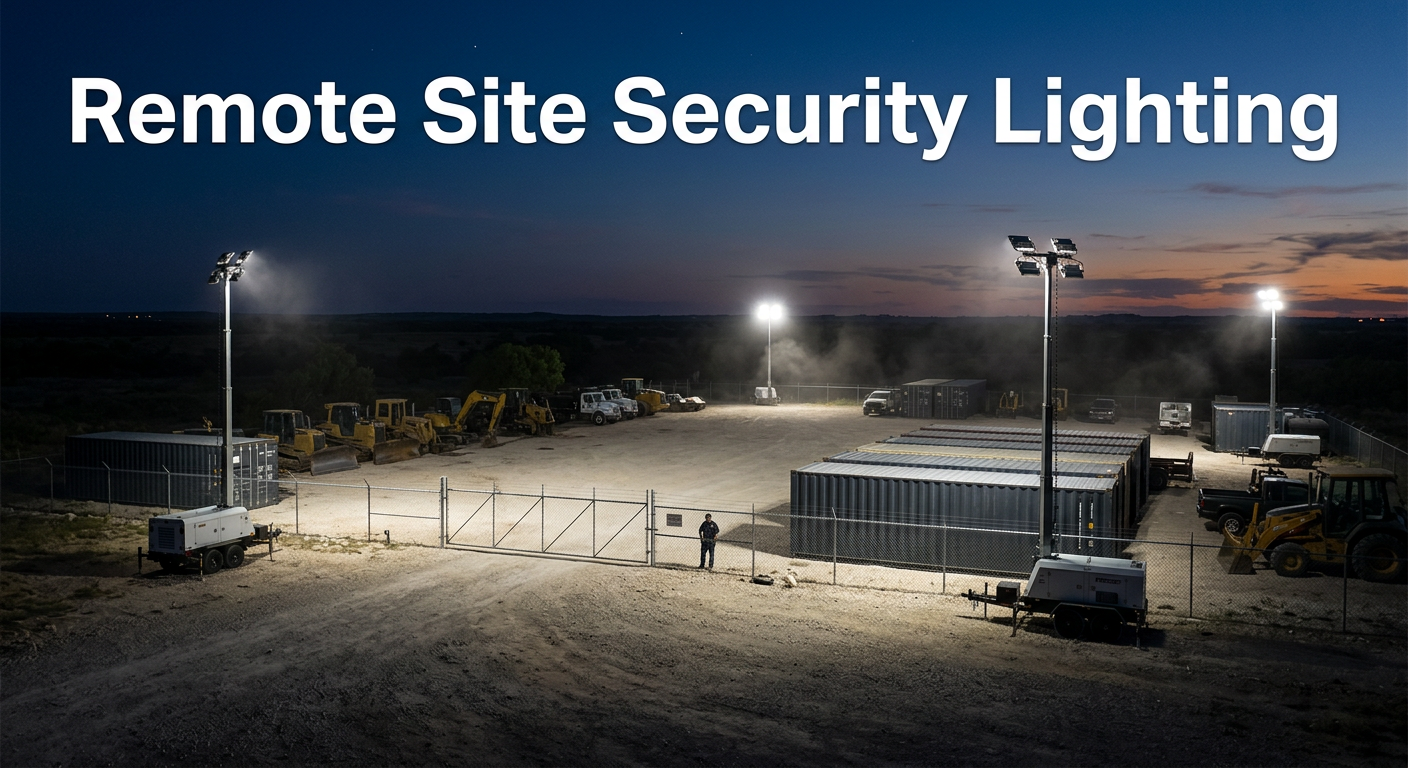
Dark pads get hit for boring reasons
A downtown Austin remodel still has traffic and neighbors. A pipeline laydown west of Midland does not. Same story on a Beaumont industrial pad after the feeders go down, or a long data center compound where copper sits for months before the fence feels finished.
Nobody needs a movie plot. Cutters walk. Copper disappears. Diesel gets siphoned. Sometimes the light tower itself gets towed because nobody can see the gate from the road. The common thread is darkness long enough for someone to work without headlights advertising them.
Locks and fencing still matter. Lighting removes the cover those controls need. Bright approaches make faces and plates readable. Even wash behind Conex stacks kills the pocket where someone cuts a lock in peace.
If your towers only sit over today’s pour, you lit productivity and left the inventory black. Flip that for after-hours risk.
Task light and security light are different jobs
Task light follows people. Security light stays on assets.
A night pour needs foot-candles on the forms. Theft needs foot-candles on the gate lock, the fuel island, and the high-value iron. Those spots go empty after 6 p.m. That is when the wrong visitors show up.
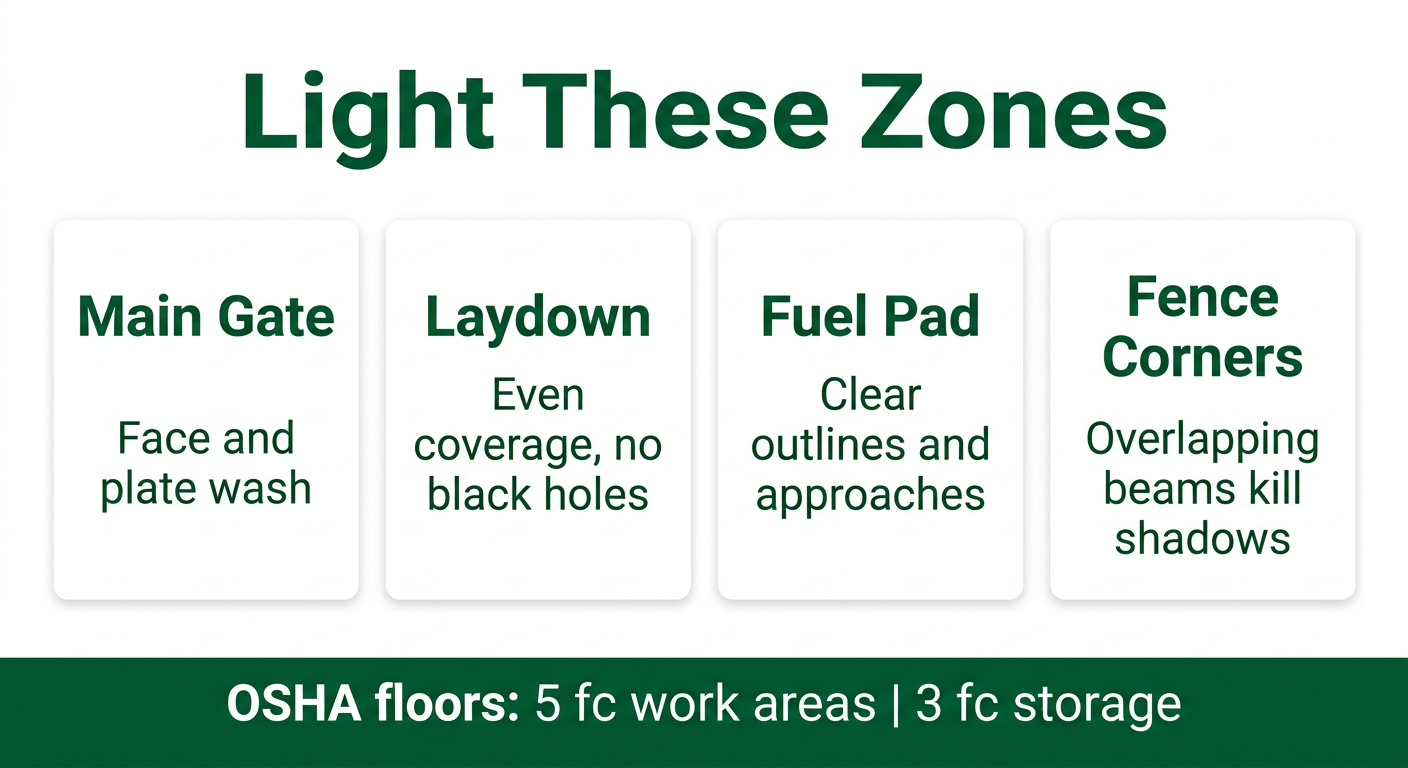
| Zone | What you are protecting | What the light needs to do |
|---|---|---|
| Main gate | Who comes in | Face and plate wash on the approach |
| Laydown | Copper, tools, generators | Even coverage, no black holes behind stacks |
| Fuel and equipment | Diesel, towables, iron | Clear outlines and approach paths |
| Trailer row | Office, records, personal gear | Perimeter wash plus entry light |
| Fence corners | Climb and cut points | Overlapping beams so shadows die |
Walk the yard after dark before you accept the layout. Daylight walks miss the holes. Your eyes will find the corner the sketch ignored.
We rent LED towers for that visibility job. We do not rent solar camera trailers. If you need cameras, that is another vendor. Your lighting plan still has to work when that truck is a week out.
What OSHA actually wants after dark
1926.26 says construction areas and storage where work is in progress get natural or artificial light. The numbers live in 1926.56 Table D-3:
- 5 foot-candles: general construction areas
- 3 foot-candles: excavation, concrete placement, access ways, active storage, loading, refueling, field maintenance
- 10 foot-candles: shops and plant areas
- 30 foot-candles: first aid and offices
There is no OSHA chapter titled “theft prevention lighting.” You still clear those floors when people or equipment are in play. And 1926.600 is blunt about iron left overnight next to a highway or an active area. Light it. Reflect it. Or barricade it with lights.
OSHA’s workplace violence prevention guide treats lighting as a control too. The checklist asks if outside, parking, and adjacent areas are bright, and if you can see clearly outside the building. Remote yards are not convenience stores. The physics is the same. Bright approaches cut the corners where someone works unseen.
Empty after-hours yards still need even perimeter wash. Deep shadow behind a material stack defeats the whole rental.
Put towers where a thief has to pause
Start with a sketch. Mark the gate, fence, fuel, laydown, and trailer row. Put light where someone has to stop.
A pattern that works on unstaffed Texas nights:
- One tower at the gate, aimed so the approach and lock are washed without blasting highway drivers.
- One or two on laydown, high enough to clear stacks, spaced so beams overlap.
- One near fuel and high-value iron so tanks and towables read from the fence.
- Extra heads or units on long fence lines where climb points sit far from the gate.
- A night walk before anyone calls the layout done.
Navy construction lighting guidance uses a planning rule: one pole can cover about four times the mounting height. Call it a start. Prove it after dark. Our how many light towers guide covers foot-candles and site size. For security, add one rule. Every high-value pile gets a wash, even if nobody is pouring there tonight.
Timers and dusk-to-dawn controls matter when the site sits empty for days. You want light when the sun drops. Not when someone remembers a breaker at 9 p.m. from town.
Remote Texas changes the logistics
Austin and Dallas yards can borrow streetlight spill sometimes. A ROW outside Odessa cannot. Neither can a Southeast Texas pad after a storm takes the lines down.
That is why portable towers with onboard generation show up out here. Delivery, fuel, and uptime are part of security. If the tower dies at 2 a.m., deterrence dies with it. The Texas light tower rental guide walks coverage and runtime. Treat fuel like a long-running genset. Our fuel management guide covers how deliveries get scheduled when town is an hour away.
Pair perimeter lighting with temporary generator power for the trailer compound. Locks, radios, and office loads stay up even if the grid never arrives. Oil and gas pads, highway laydowns, and long data center compounds share the same profile. Expensive stuff sitting still through long dark hours. We covered the oilfield power side in mobile office power for oil and gas. Lighting is the after-hours half of that problem.
Texas wind and dust punish lazy setups. Stake and level every tower. Check mast locks after a front blows through. A tipped unit is a safety mess and a dark hole in your perimeter.
Mistakes that leave the wrong parts dark
Lighting only the pour. The crew goes home. The copper does not.
One bright spot in the middle of a big yard. You get a lit island and black edges. Thieves work the edges.
Ignoring the gate approach. If plates and faces cannot be read, the gate light failed even if the lumen sheet looks fine.
No fuel plan. Remote sites run dry on holiday weekends. Empty tanks equal open gates.
Assuming cameras replace light. Cameras need photons. A dark yard gives you black rectangles and false comfort.
Leaving highway-adjacent iron unmarked. OSHA’s equipment night-marking rule does not care that the site “feels rural.”
Ask these before you rent for security lighting
Can towers be aimed for gate, laydown, fuel, and fence, not only night work zones?
Who owns fuel delivery, and what happens if a unit dies at 2 a.m.?
Do units support dusk-to-dawn or timer operation for empty nights?
Can the fleet move as the laydown shifts without starting the contract over?
Will someone walk the site after dark once before accepting the layout?
Do you need temporary power for trailers and security loads in the same mobilization?
If the conversation only talks about “towers per acre,” push for asset-based placement. Acreage without a gate plan is a guess.
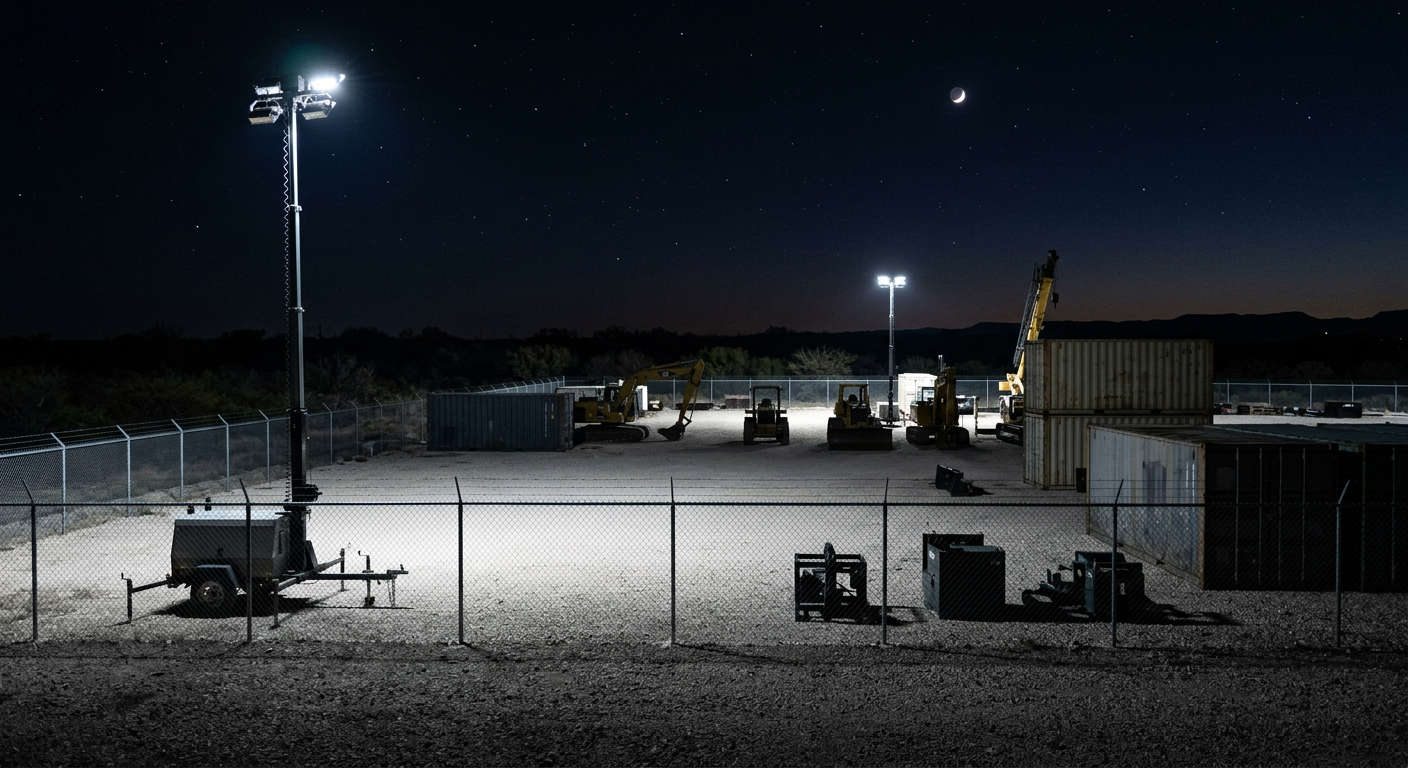
Remote after-hours risk is a lighting problem before it is a camera problem. Map the assets. Hit OSHA floors where people and equipment move. Overlap beams on the fence and the piles. Keep fuel and uptime in the same plan as mast height.
We work remote and urban sites across Austin, Dallas, San Antonio, Fort Worth, Waco, and the wider Texas network. If you are staging a pad and want the gate and laydown lit before the first night shift goes home, contact us at (866) 448-1594. We’ll map towers to the assets, not just to the pour.
FAQ
What is construction site security lighting?
Temporary outdoor lighting placed to deter theft and trespass after hours. Usually at gates, laydown, fuel, and fence lines. Portable light towers handle it when permanent power is not there.
How bright does security lighting need to be?
Match OSHA’s work-area floors when people or equipment are active: 5 foot-candles for general construction, 3 for storage and access ways. Empty after-hours yards need even perimeter wash with no deep shadows behind stacks.
Do light towers replace cameras?
No. Light towers remove darkness. Cameras record what happens in that light. Run both if your risk plan calls for it. Lighting still has to work if the camera vendor is delayed.
How many towers does a remote yard need?
Enough to cover gate, laydown, fuel, and fence blind spots with overlapping beams. Small pads often start at 2 to 3. Larger compounds follow site size plus asset layout in our tower count guide.
Should security lighting run all night?
Yes on unstaffed remote sites. Use dusk-to-dawn or timers so the yard is lit when the sun drops, not when someone remembers a switch. Factor fuel burn into the weekly delivery plan.