
Key Takeaways
- OSHA requires a minimum 3 to 5 foot-candles of light depending on your work area type.
- One light tower covers 15,000 to 40,000 square feet.
- Space towers four times the height apart for even coverage.
- Most job sites need 1 to 4 towers based on size and task type.
- Poor lighting costs money through safety violations and project delays.
- Light towers prevent accidents and boost worker efficiency.
- Mobile lighting solutions save setup time compared to permanent pole installation.
Your job site needs enough light to keep workers safe and productive. The number of light towers depends on three things: site size, work type, and OSHA rules. Most small to mid-size construction projects need 1 to 4 towers. The right lighting setup prevents accidents, meets legal standards, and gets work done faster.
What Does OSHA Require?
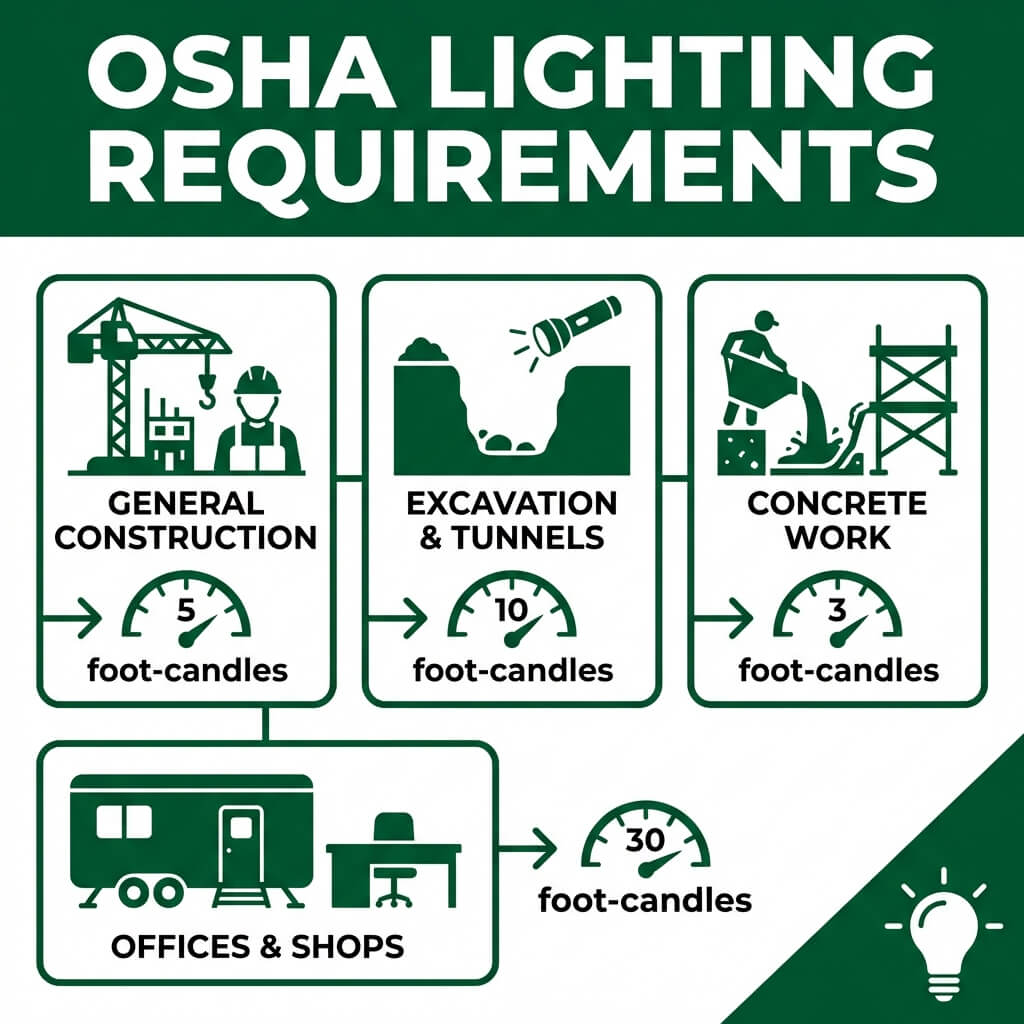
OSHA has clear lighting rules for construction. Different work areas need different light levels.
General construction areas require 5 foot-candles of light. Areas like concrete placement and excavation need 3 foot-candles. Offices and first aid stations need much more: 30 foot-candles.
Not meeting these standards is risky. OSHA fines reached $16,550 per violation in 2025. A single lighting failure can be expensive and dangerous.
How Much Area Does One Tower Cover?
Tower coverage varies by model and setup. Standard lighting towers illuminate 15,000 to 40,000 square feet. This depends on light power, height, and beam angle.
The math is simple. One foot-candle equals one lumen per square foot. To find lumens needed, multiply required foot-candles by your area size. A 500-square-foot work zone needing 5 foot-candles requires 2,500 lumens minimum.
Taller towers reach farther. A 40-foot tower covers more ground than a 20-foot tower. But height isn’t everything—lamp strength and reflector design matter too.
How Should You Space Multiple Towers?
Single towers rarely light entire job sites. You need a spacing rule for good coverage.
Space towers four times their mounting height apart. For example, 20-foot towers should be 80 feet apart. This creates even, overlapping light with no dark spots.
Another method: make tower height half your work area width. If your site is 100 feet wide, use 50-foot towers. This ensures solid coverage across the full area.
How Many Towers Do Different Sites Need?
Site size drives tower count. Small sites are quick. Large sites need more planning.
Small residential sites (under 5,000 sq ft) typically need 1 to 2 towers. Think deck work, garage building, or minor landscaping.
Mid-size commercial (5,000 to 20,000 sq ft) usually need 2 to 3 towers. These include typical commercial builds and parking lot work.
Large construction (over 20,000 sq ft) often need 3 to 6 towers or more. Major road projects, shopping centers, and large buildings fall here.
Safety tasks also matter. Excavation requires more light than finishing work. Heavy equipment operation needs better lighting than framing. Different industries have unique lighting demands based on their specific tasks and timelines.
What About Different Work Types?
Not all work needs equal light. OSHA recognizes this in their rules. Here’s what each work area requires:
| Work Type | Required Foot-Candles | Examples |
|---|---|---|
| General construction areas | 5 | General site work, ramps, runways |
| Excavation & concrete work | 3 | Digging, pouring, site prep |
| Access ways & storage | 3 | Loading platforms, refueling areas |
| Indoor corridors & exits | 5 | Hallways, stairways, emergency exits |
| General shops & plants | 10 | Construction staging areas, equipment maintenance |
| First aid & offices | 30 | Medical stations, administrative areas, detailed work |
Your tower count depends on matching OSHA needs to your specific tasks. Excavation and concrete work requires 3 foot-candles. These areas see constant activity and equipment movement. Better lighting prevents collisions.
General construction plant and shop areas require 10 foot-candles. Work is precise, and small errors matter. More light keeps accuracy high.
First aid and office areas need 30 foot-candles. People work in detail here. Medical response requires seeing clearly.
Why Choose Mobile Light Towers?
Mobile towers offer big advantages over fixed pole lights. Setup is fast—hours instead of days. You move towers as work progresses. You pay only for what you use, then remove equipment when done.
Portable towers also deliver reliable light. They come maintained and fueled. Your team focuses on work, not light system upkeep. Mobile office power solutions work the same way—your team gets what you need, when you need it, without managing equipment yourself.
How to Calculate Your Needs
Here’s a practical method:
- Measure your work area in square feet.
- Identify your task type from OSHA rules.
- Multiply area by required foot-candles to get lumens needed.
- Check tower specs for their lumen output.
- Divide total lumens by tower lumens to find tower count.
Example: 10,000 sq ft site. Concrete work needs 3 foot-candles. That’s 30,000 lumens needed. If your tower produces 6,000 lumens, you need 5 towers. Space them 80 feet apart if they’re 20-foot models.
Conclusion
The right number of light towers keeps your job site safe, legal, and productive. Start by checking OSHA requirements for your work type. Measure your area. Calculate lumens needed. Then plan tower placement using proper spacing rules.
Most sites need 1 to 4 towers. Your exact count depends on size and task type. Mobile lighting towers deliver flexibility without hassle. They prevent accidents, speed up work, and meet safety laws.
Ready to light up your job site? Contact JC Davis Power for a site assessment. We provide mobile site lighting solutions tailored to your project needs. Let our experts help you get the right lighting setup.