
Key Takeaways
- Diesel gelling is wax in the fuel coming out of solution in the cold. It clogs filters and can stop a generator cold.
- It starts at the cloud point, when the fuel turns hazy. Chevron says fuel stops flowing at roughly 6°F to 10°F below the cloud point if it has no additive.
- There’s no single gelling temperature. It depends on the fuel in your tank, so ask your supplier for the cloud point.
- Anti-gel additives only work if they’re mixed in before wax forms. Treating gelled fuel is too late.
- Texas freezes are rare, not impossible. DFW once sat 295 hours straight below freezing.
- The fix is a plan: winter fuel, additives, a block heater, fresh filters, and a fuel supplier who’ll show up in an ice storm.
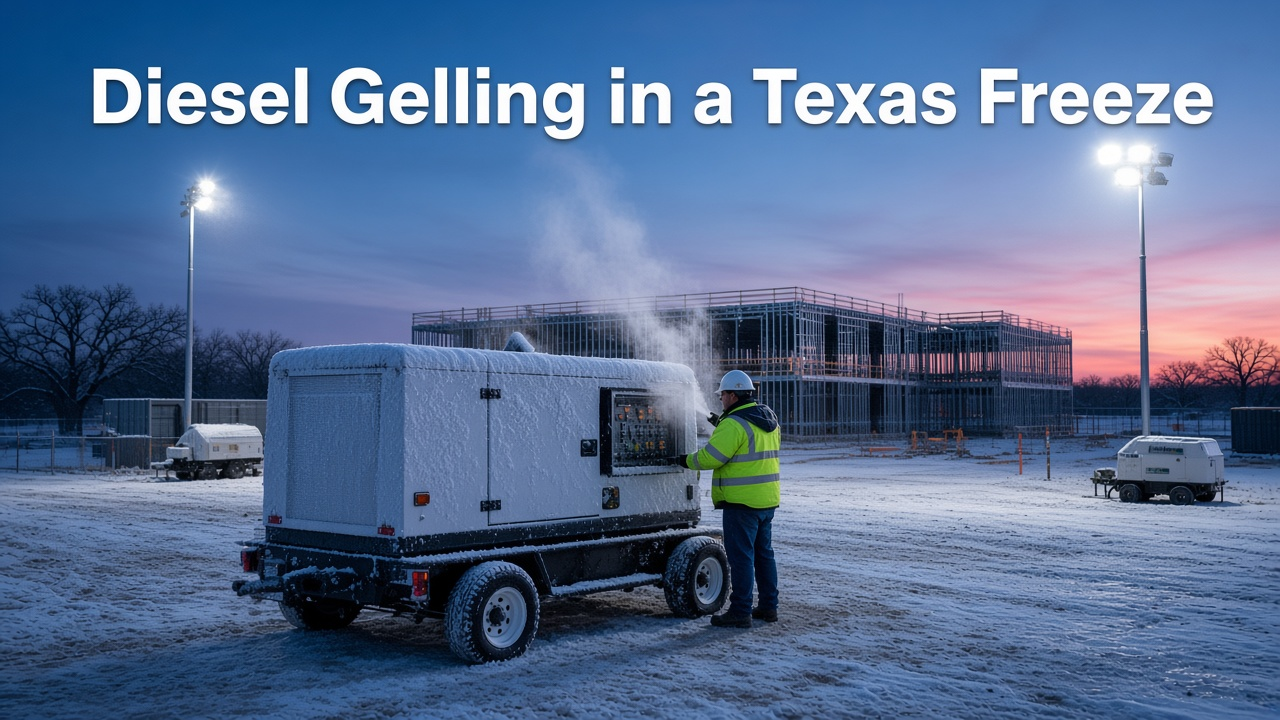
Most Texas sites go all winter without thinking about fuel. Then a hard front comes through on a Friday, the site sits idle for the weekend, and Monday morning the generator won’t stay running.
A lot of the time, the battery’s fine. The fuel turned to slush in the filter.
What diesel gelling is
All diesel has paraffin wax in it. When it’s warm, the wax stays dissolved. When it gets cold, it doesn’t.
Chevron’s Diesel Fuels Technical Review breaks it into stages:
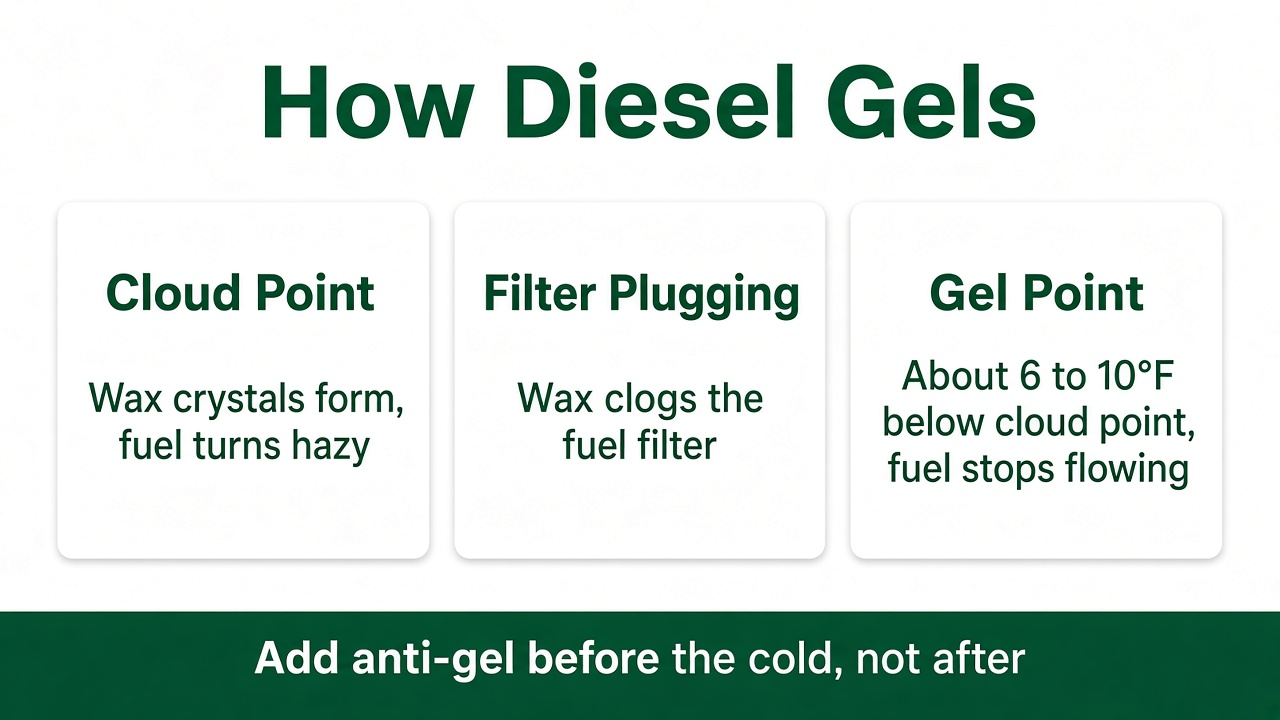
- Cloud point. Wax crystals start to form and the fuel looks hazy. It’s measured with ASTM D2500.
- Filter plugging. As more wax comes out, crystals catch in the fuel filter. Some fuel systems plug right at the cloud point. Others keep running a few degrees below it.
- Pour point, or gel point. About 3°C to 5°C (6°F to 10°F) below the cloud point, fuel without a pour point additive gets so thick it won’t flow. That’s the point where people say the fuel has gelled.
Your generator doesn’t need fully gelled fuel to quit. A filter caked with wax starves the engine long before the tank looks like jelly.
What temperature does diesel gel at?
That’s the question everyone asks, and the honest answer is: it depends on the fuel.
ASTM D975, the U.S. diesel spec, doesn’t set a cold-weather limit. The CRC’s low-temperature guide explains that the spec leaves cold properties to be agreed between the fuel supplier and the buyer. Chevron notes that D975 offers a guideline that the cloud point is a fair sign of the low-temperature limit for fuel without cold-flow additives.
So the number that matters is your fuel’s cloud point. Two loads of No. 2 diesel can have very different ones, depending on the crude, the refinery, and the season it was blended for.
Biodiesel blends add another wrinkle. CRC notes that biodiesel components typically have cloud points of -5°C to +15°C (23°F to 59°F), higher than most diesel. A biodiesel blend can raise the cloud point of the fuel you got delivered.
What to do: ask your fuel supplier for the cloud point of the fuel they’re delivering this winter. If they can’t tell you, find out before the first freeze, not during it.
Why Texas sites get caught
In the north, everyone runs winter fuel and plugs in block heaters by habit. In Texas, a hard freeze is rare enough that nobody plans for it.
But it happens. The National Weather Service’s record of North Texas cold waves includes December 1983, when DFW sat a record 295 consecutive hours below freezing and power supplies were strained. It lists a December 1989 cold wave that set record power demands, and a 1996 stretch of five straight days below freezing with a low of 8°F.
Job sites have a few extra problems:
- Tanks sit outside. A generator’s base tank and fuel lines have no heat except what the engine makes.
- Sites go idle. A holiday shutdown or a weekend off means the engine is cold and the fuel is sitting still for days.
- The fuel was bought in the fall. Fuel delivered in a warm October may not be treated for a January front.
- Roads close. When the freeze hits, fuel trucks have the same icy roads everyone else does.
How to winterize a diesel generator
Here’s the checklist we work through before winter on our rental fleet, and what we’d tell anyone running their own units.
1. Get winter fuel or treat it early
Chevron says that once fuel is out in the distribution system, blending in No. 1 diesel is the most practical way to improve cold performance. No. 1 has less wax. Your supplier can deliver a winter blend.
2. Add anti-gel before the cold, not during it
Cold-flow additives change the size and shape of wax crystals so they pass through the filter. But Chevron is clear that they must be blended into the fuel before any wax has formed. It also notes that a given additive won’t work equally well in every fuel. Treat when the forecast turns, while the fuel is still warm, and follow the product’s dosing.
3. Get the water out
Water in fuel freezes into ice that blocks lines and filters, the same as wax. Drain the water separators, check the tank bottom, and keep tanks topped off to cut down on condensation.
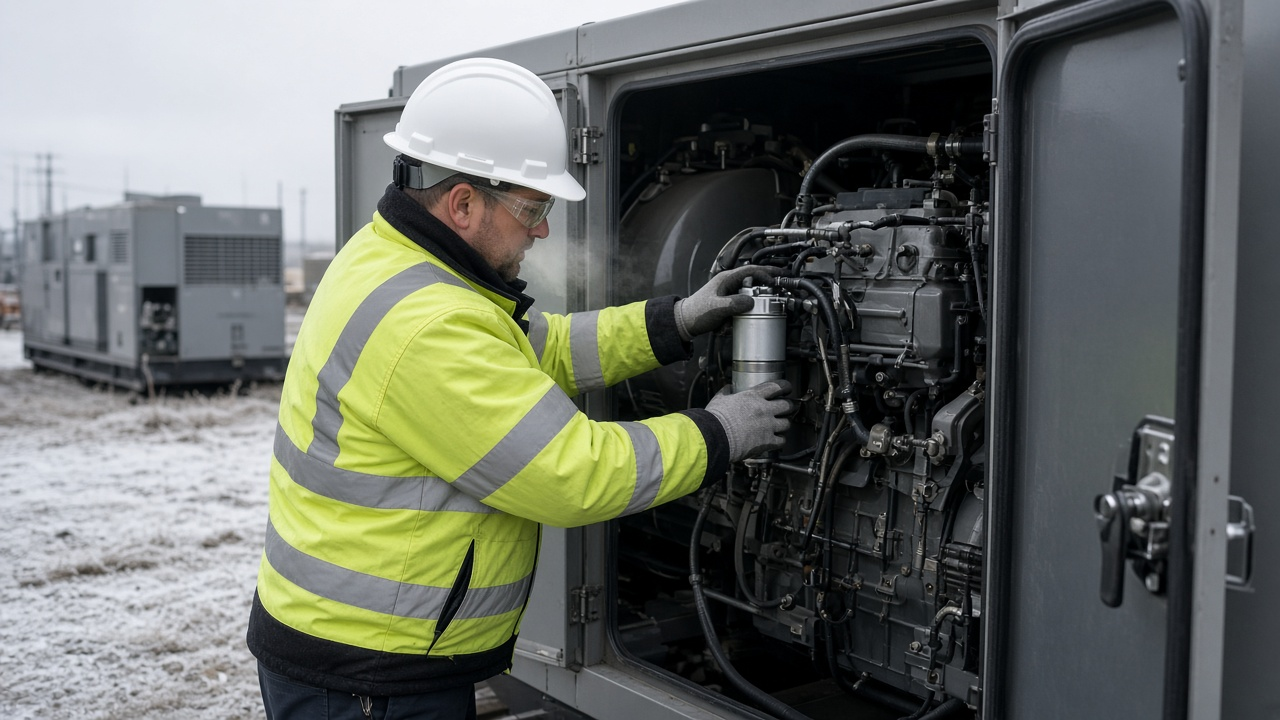
4. Change the fuel filters
A filter that’s half full of dirt plugs with a lot less wax. Start winter with fresh filters, and keep spares on site.
5. Use a block heater
A block heater keeps the coolant and engine warm while the generator sits, so it starts easier and warms up faster. It helps the engine, not the fuel in the tank. You still need the fuel steps above. On sites with a power source, plug it in. On remote sites, plan for it.
6. Check the batteries
NFPA says battery failure is the most common reason generators fail. Cold makes a weak battery weaker. Test them before the first freeze, and clean the terminals.
7. Don’t let it sit idle
If a generator will sit for days in the cold, start it and run it under load on a schedule so the fuel moves and the engine warms up. If it won’t start on a cold morning, see our generator not starting troubleshooting guide.
8. Line up fuel before the storm
Top off tanks before a front arrives. Know who’s delivering, how often, and what happens if the roads ice over. Our fuel management guide covers delivery planning for long jobs.
If it’s already gelled
If the generator has quit and you suspect gelled fuel:
- Don’t keep cranking. You’ll drain the batteries and won’t move gelled fuel.
- Warm the fuel system. Get the filter, lines, and tank warmer, using safe, approved heat only. Never use an open flame near fuel.
- Change the filter. A wax-packed filter won’t clear on its own.
- Use an emergency de-gel product made for gelled fuel, following the label. Regular anti-gel doesn’t fix fuel that’s already gelled.
- Call your fuel and service provider. On a rental, that’s us.
What a winterized rental looks like
If you’re renting, ask what the rental company does for winter. On temporary generator power from JC Davis Power, the job includes fuel management, scheduled maintenance, 24/7 monitoring, and rapid-response technicians. In winter, that means we plan fuel, filters, and service around the forecast, not after the call.
Freezes also bring more than gelling. Crews need heat, and some sites need backup power for the whole storm. See temporary heating for Texas construction and how winter generator rentals keep businesses running.
Get your site ready before the next front
We run generators on job sites across Austin, Dallas, San Antonio, Fort Worth, Waco, and the wider Texas network, and we keep them fueled and serviced through the cold. If you want a generator that’s ready for a freeze, or want us to take fuel off your plate this winter, contact us or call (866) 448-1594.
FAQ
What is diesel gelling?
Diesel gelling is when wax in diesel fuel comes out of solution in cold weather. The fuel turns cloudy, wax clogs the fuel filter, and if it gets colder still, the fuel gets too thick to flow.
At what temperature does diesel gel?
There’s no single number. It depends on the fuel. Wax starts to form at the cloud point, and fuel without a pour point additive stops flowing about 6°F to 10°F below that. Ask your supplier for the cloud point of the fuel you’re getting.
Does anti-gel work on gelled fuel?
No. Regular anti-gel additives have to be mixed in before wax forms. If the fuel has already gelled, you need to warm the fuel system, change the filter, and use an emergency de-gel product made for that.
Does a block heater stop diesel from gelling?
Not by itself. A block heater keeps the engine and coolant warm so the generator starts easier. It doesn’t heat the fuel in the tank. You still need winter fuel or an additive and a clean filter.
How do I winterize a diesel generator?
Use winter-blend fuel or add anti-gel early, drain water from the fuel system, change the fuel filters, plug in a block heater, test the batteries, run the unit under load on a schedule, and top off fuel before a freeze.