
Key Takeaways
- A 100 kW diesel generator burns roughly 5.80 gallons per hour at 75% load, a standard 10-hour shift consumes about 58 gallons
- A 200 kW unit running 10 hours a day at 75% load uses approximately 110 gallons, plan your fuel budget before the project starts, not during
- OSHA 29 CFR 1926.152 governs flammable liquid storage on construction sites; diesel tanks must be positioned at least 25 feet from ignition sources and on stable, leak-proof foundations
- Sites storing more than 1,320 gallons of diesel above ground must have a formal EPA Spill Prevention, Control, and Countermeasure (SPCC) plan
- Managed fuel delivery, where your rental provider handles refueling, monitoring, and compliance, eliminates the most common cause of unplanned generator downtime: running dry
Fuel is the part of generator rental that most project managers think about last. They size the equipment, schedule the delivery, and confirm the transfer switch, then figure out fueling on the fly. That’s when problems start. A well-run fuel management plan keeps your site running around the clock without scrambling for a fuel truck at 2 a.m.
How Much Fuel Does a Rental Generator Actually Burn?
The rule of thumb for diesel generators is roughly 0.1 gallons of fuel per kilowatt-hour at full load. In practice, most construction site generators run at 50–75% load, not full capacity, which changes the math.
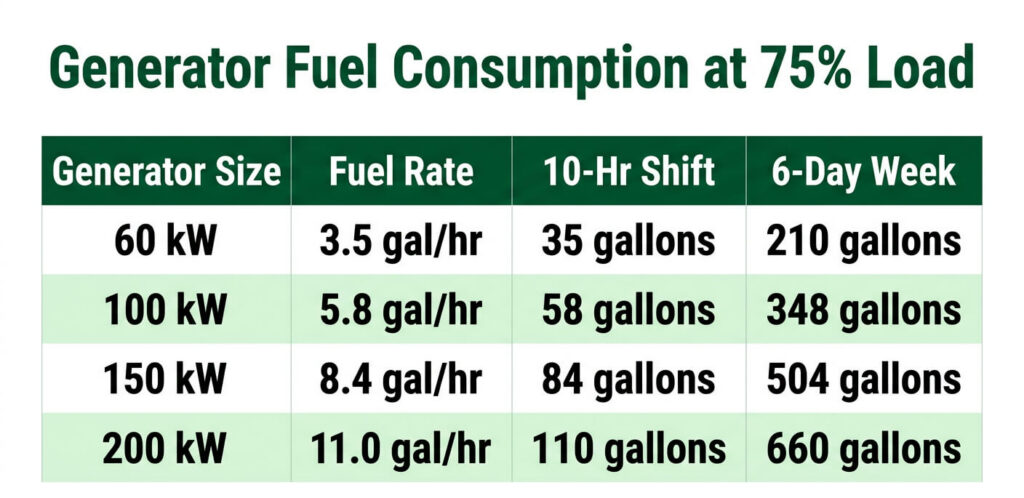
Here’s what that looks like for the sizes most common on Texas job sites:
| Generator Size | Fuel Use at 75% Load | 10-Hour Shift | 6-Day Week |
|---|---|---|---|
| 60 kW | ~3.5 gal/hr | ~35 gallons | ~210 gallons |
| 100 kW | ~5.8 gal/hr | ~58 gallons | ~348 gallons |
| 150 kW | ~8.4 gal/hr | ~84 gallons | ~504 gallons |
| 200 kW | ~11.0 gal/hr | ~110 gallons | ~660 gallons |
Source: Hardy Diesel Fuel Consumption Chart, estimated values at 75% load
Most rental generators include a belly tank, an integrated fuel tank built into the generator frame, typically holding 100 to 500 gallons depending on the unit. A 100 kW generator with a 200-gallon belly tank runs about 34 hours before refueling. That’s roughly three full shifts on a fast-moving project. Without a scheduled refueling plan, you’re counting on someone remembering to check the gauge before it hits empty.
What Managed Fuel Delivery Actually Includes
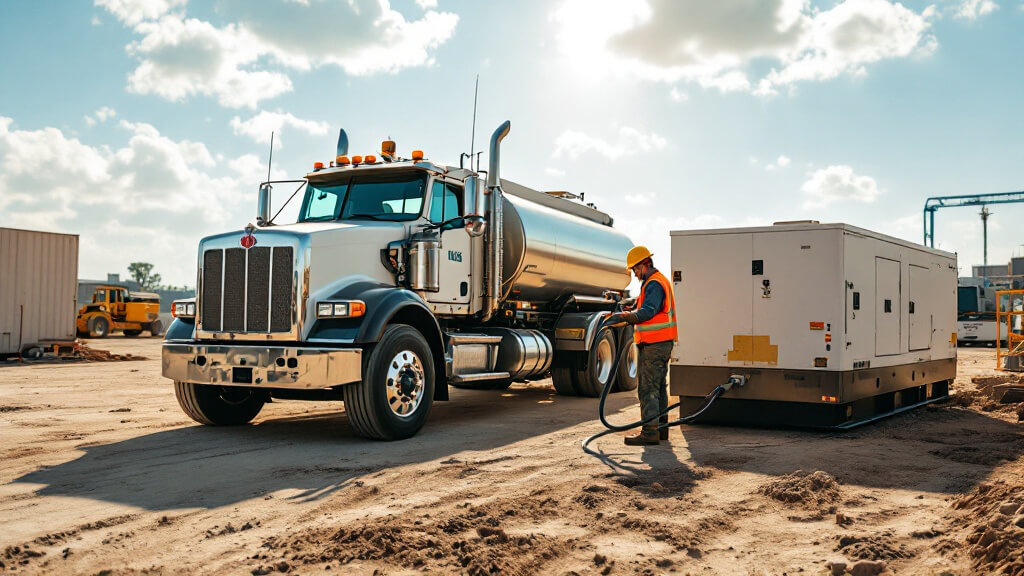
Managed fuel delivery is not just a truck showing up with diesel. A full-service approach covers four things: scheduled refueling based on your projected runtime, remote fuel level monitoring so no one has to physically check the tank, emergency top-offs when the schedule shifts, and documentation that keeps your site compliant.
JC Davis Power’s managed power solutions are built around this model. When you rent a generator, our team tracks fuel consumption against your project schedule, not against a fixed calendar, and adjusts delivery frequency as load demands change.
That matters in Texas heat. Generator load increases when air conditioning units on-site run harder. A unit consuming 8 gallons an hour in April may run closer to 10 gallons per hour in July. If your fuel delivery schedule doesn’t account for that, you’ll be short before the end of the week.
For a breakdown of what drives fuel efficiency across different generator types, our guide on generator fuel efficiency and environmental impact covers that in detail.
Storing Diesel on a Job Site – The Rules You Can’t Ignore
Diesel fuel is classified as a flammable liquid under OSHA 29 CFR 1926.152. That standard sets specific requirements for how fuel is stored, handled, and contained on construction sites. Ignoring them isn’t just a safety risk, it’s a citation waiting to happen.
The key rules:
- Distance requirements: Diesel storage tanks must be at least 25 feet from ignition sources, welding stations, open flames, and the generator itself, and 40 feet from any structure or building. Tanks must sit on stable, level, leak-proof foundations.
- Secondary containment: Any diesel storage tank requires a containment basin sized at 110% of the tank’s total volume. For a 500-gallon tank, that means a basin holding at least 550 gallons. Double-walled tanks satisfy this on their own.
- SPCC threshold: If your site stores more than 1,320 gallons of oil or diesel in aboveground containers, the EPA’s Spill Prevention, Control, and Countermeasure rule requires a formal written SPCC plan. That plan must identify discharge risks, prevention measures, and spill response procedures.
- Containers: Only DOT/UN-approved containers are permitted for diesel transport and interim storage. Standard red plastic safety cans are not compliant for diesel in construction volumes, they’re rated for small quantities of gasoline.
If you’re running multiple generators across a large site, the aggregate volume across all tanks counts toward the 1,320-gallon threshold. We see projects exceed that total without realizing it.
For projects in Austin, Dallas, San Antonio, or anywhere across Texas, our team handles these compliance requirements as part of the generator rental setup, proper placement, containment documentation, and site-specific fueling plans included.
The Hidden Cost of Running Out of Fuel Mid-Project
Generator fuel runout is more disruptive than most project managers expect the first time it happens.
The obvious damage is immediate: equipment shuts down, work stops. But the real cost shows up after. Diesel engines that run dry draw air into the fuel lines. Before the unit restarts, someone needs to bleed the fuel system, a process that takes 30 minutes to 2 hours depending on the engine. On a pressured schedule, that’s not a maintenance issue. It’s a delay that compresses everything downstream.
There’s also the issue of load re-synchronization. If the generator powers a mobile office trailer or sensitive equipment, a hard shutdown can corrupt data, trip breakers, or require manual reset across the panel. Some equipment won’t restart cleanly without a technician on site.
Managed fuel delivery eliminates this scenario. With remote tank monitoring, our team gets an alert when your tank drops below a set threshold, typically 25–30%, and schedules a delivery before you reach empty. You don’t have to track it. We do.
Our post on common generator rental scenarios in Austin walks through how this plays out on longer-duration projects specifically.
How Tier 4 Generators Change the Fuel Equation
Tier 4 Final is the EPA’s most stringent diesel emissions standard for nonroad engines. All new generator sets rated for prime or mobile use must meet Tier 4 Final regulations, which require advanced after-treatment systems, primarily diesel particulate filters (DPF) and selective catalytic reduction (SCR) systems.
The tradeoff most contractors don’t expect: Tier 4 engines are more fuel-efficient than older Tier 2 or Tier 3 units at comparable load. The combustion process runs cleaner and more completely, which means more of the fuel converts to usable energy rather than unburned particulate.
That efficiency gap is meaningful on long projects. A Tier 4 100 kW unit running 60 days on a site can consume 10–15% less fuel than an older-generation unit doing the same work. At $3.50–$4.00 per gallon of off-road diesel, that adds up.
There’s a fuel quality consideration too. Tier 4 after-treatment systems, particularly SCR systems using diesel exhaust fluid (DEF) are sensitive to sulfur content. Ultra-low sulfur diesel (ULSD) with a maximum of 15 parts per million sulfur is required. Standard on-road diesel in Texas already meets this standard, but if you’re sourcing fuel from non-standard suppliers on remote sites, verify the spec before you fill the tank.
For a deeper look at fuel type trade-offs across generator configurations, our guide on diesel vs. natural gas vs. propane for Texas projects covers the practical differences.
If you want fuel management handled as part of your rental, scheduled delivery, tank monitoring, and compliance documentation included, reach out to our team. We serve construction sites, industrial projects, and long-term rentals across Texas and surrounding states. Get in touch with JC Davis Power to talk through what your project actually needs.
Frequently Asked Questions
Q: How often does a rental generator need to be refueled on a typical construction site?
A: It depends on generator size and load. A 100 kW unit running at 75% load burns roughly 5.8 gallons per hour. With a standard 200-gallon belly tank, that’s about 34 hours of runtime before refueling, or every 3 to 3.5 working days on a 10-hour schedule. Larger units or higher loads shorten that window considerably.
Q: Does OSHA require secondary containment for diesel generator fuel on job sites?
A: Yes. Under OSHA 29 CFR 1926.152 and EPA guidelines, diesel tanks on construction sites require secondary containment equal to 110% of the tank’s volume. Double-walled tanks meet this on their own. Single-wall tanks need a separate containment berm or basin. Failure to comply can result in citations, fines, and work stoppages.
Q: What happens to a diesel generator if it runs completely out of fuel?
A: Running dry pulls air into the fuel lines, which prevents the engine from restarting without manual intervention. Bleeding the fuel system takes 30 minutes to 2 hours. On engines with common-rail injection or sensitive fuel delivery components, the process is more involved. Managed fuel delivery with remote tank monitoring prevents this by scheduling refueling before tanks drop below 25–30%.
Q: Do Tier 4 generators use more fuel than older models?
A: No, they typically use less. Tier 4 Final engines burn diesel more completely due to advanced combustion design, which means more energy output per gallon. Over a 60-day project, a Tier 4 100 kW unit can consume 10–15% less fuel than a comparable older-generation unit. They do require ultra-low sulfur diesel (ULSD) with a maximum of 15 ppm sulfur, standard in Texas, but worth confirming on remote or specialty fuel sources.