
If you’re comparing two generator rentals and one is rated in kVA while the other is rated in kW, you’re not comparing the same number, and that gap can cost you a unit that’s the wrong size. The quick answer: kW = kVA × power factor, and for most job-site generators the power factor is 0.8, so a 25 kVA generator delivers about 20 kW of real power. This guide explains what those units mean, how to convert between them, and how to read a spec sheet so you know exactly what you’re renting. If you already know your load and just need the right unit, our generator sizing guide walks through that calculation.
In this article:
- What kW, kVA, and power factor actually measure, in plain English
- The exact formula to convert kVA to kW and back
- A quick-reference conversion chart at 0.8 power factor
- How three-phase power changes the math on larger units
- Which spec-sheet numbers matter when you compare rental generators
kW vs. kVA: What Each One Measures
Key takeaway: kW is the real power your equipment uses. kVA is the total power the generator must supply. The gap between them is power factor.
kW (kilowatts) is real power. It is the working power your tools, lights, and motors use to do their job. kVA (kilovolt-amperes) is apparent power, the total power the generator has to produce. That total includes the real power plus the reactive power that motors and transformers pull but never turn into work. In short: kW is what you use. kVA is what the generator has to deliver. That gap is why a generator’s kVA rating is always equal to or larger than its kW rating, never smaller.
A useful way to picture it: think of a glass of beer. The liquid is your real power (kW), the foam is reactive power, and the full glass, liquid plus foam, is apparent power (kVA). You paid for the whole glass, but only the liquid does the work.
With the two units defined, the piece that links them is power factor.
Power Factor: The Number That Connects Them
Key takeaway: Power factor is the ratio of real power to apparent power. It runs from 0 to 1, and most job-site generators are rated at 0.8.
Power factor is the ratio of kW to kVA, a measure of how efficiently the supplied power gets converted into useful work. A power factor of 1.0 means every bit of supplied power does work (purely resistive loads like heaters), while motors and inductive loads drop it toward 0.8 or lower. This matters because generator manufacturers rate industrial units at a standard 0.8 power factor, so if you ignore it you’ll overestimate the real power a kVA-rated unit can deliver.
Most construction and industrial sites run motors, compressors, and HVAC, all inductive loads, so a 0.8 power factor is a safe planning assumption. Resistive loads like electric heaters and incandescent lighting run closer to 1.0, but they rarely dominate a job site.
Now that power factor is clear, the conversion itself is straightforward.
How to Convert kVA to kW (and Back)
Key takeaway: To convert kVA to kW, multiply by the power factor; to convert kW to kVA, divide by the power factor.
The two formulas are all you need:
kW = kVA × power factorkVA = kW ÷ power factor
At the standard 0.8 power factor, a 100 kVA generator delivers 80 kW of real power, and a load of 80 kW requires a 100 kVA generator. Get this backward, dividing when you should multiply, and you can under-order a unit by 20% or more, which is exactly how a rental trips under load on day one.
Here’s a quick example. Your load list adds up to 40 kW of real power. Divide by 0.8: you need a 50 kVA generator, not a 40 kVA one. That 10 kVA difference is the reactive power the spec sheet accounts for and a quick mental estimate misses.
For sites with unusual loads or a mix of resistive and inductive equipment, confirming the actual power factor is worth doing before you commit, a topic covered in our look at common generator sizing mistakes.
A chart makes the everyday conversions instant.
kVA to kW Conversion Chart (at 0.8 Power Factor)
Key takeaway: At the standard 0.8 power factor, real power in kW is always 80% of the kVA rating.
Use this chart for fast reference when comparing rental units. All values assume a 0.8 power factor, the industrial standard.
| kVA | kW (at PF 0.8) |
|---|---|
| 10 | 8 |
| 20 | 16 |
| 25 | 20 |
| 40 | 32 |
| 60 | 48 |
| 100 | 80 |
| 125 | 100 |
| 150 | 120 |
| 200 | 160 |
| 250 | 200 |
| 500 | 400 |
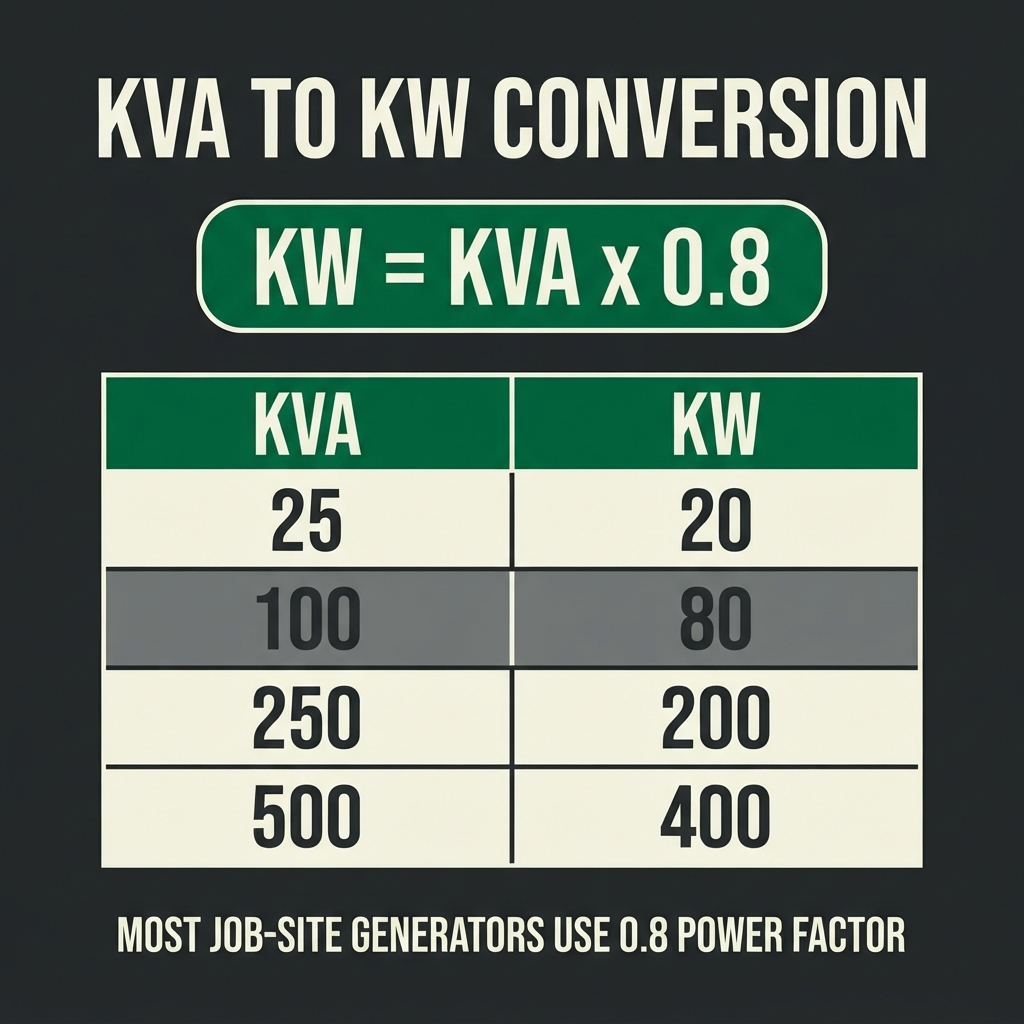
If a rental company quotes you kVA and your load list is in kW, this chart tells you in one glance whether the unit clears your requirement. When the power factor of your equipment differs from 0.8, recalculate with the actual figure using the formula above.
Larger units introduce one more variable: three-phase power.
Three-Phase Power: Where the Math Changes
Key takeaway: For three-phase generators, apparent power (kVA) is calculated from line-to-line voltage and current using the formula kVA = (√3 × V × A) ÷ 1,000.
Single-phase power is common on small units, but most industrial and large job-site generators are three-phase, which delivers power more efficiently for heavy motor loads. The three-phase apparent-power formula is kVA = (√3 × volts × amps) ÷ 1,000, where √3 is approximately 1.732 and volts is the line-to-line voltage. You rarely have to run this by hand, the spec sheet lists it, but knowing where the number comes from helps you sanity-check a quote.
For example, a three-phase generator at 480 volts supplying 120 amps produces: 1.732 × 480 × 120 ÷ 1,000 ≈ 100 kVA, or about 80 kW at 0.8 power factor. That’s the same 100 kVA / 80 kW relationship, now traced back to the voltage and amperage on the nameplate.
With the math settled, the last step is knowing which spec-sheet numbers to trust.
Reading a Generator Spec Sheet Without Getting Fooled
Key takeaway: Compare generators on the same basis: real power (kW) at the same power factor. And check whether the rating is prime or standby before you decide.
The single most important habit is comparing apples to apples: convert every unit to kW at the same power factor before you compare rental options, so a kVA-rated unit and a kW-rated unit line up on the same scale. A generator that looks bigger on paper because it’s quoted in kVA may deliver the same real power as a smaller-sounding kW-rated unit.

Two more numbers deserve a second look:
- Prime vs. standby rating, Prime power is the continuous output a generator can sustain for long runs; standby is a higher, short-duration rating for emergencies. Size a job-site rental on the prime rating, not the standby number, as the NEC requirements for generators make clear.
- Power factor stated on the sheet, Confirm it’s 0.8 before you trust the kW figure. A different power factor changes the real-power output.
Whatever the numbers say, the connection itself has to meet OSHA’s electrical standards for construction (29 CFR 1926.402), a correctly sized generator still has to be hooked up safely.
If a spec sheet leaves you unsure whether a unit clears your load, that’s the moment to talk to a rental provider rather than guess. JC Davis Power sizes temporary generator power to your actual load and handles delivery, fuel, and maintenance on a flat monthly rate. Contact the team with your kW or kVA requirement and we’ll confirm the right unit.
Frequently Asked Questions
How do I convert kVA to kW?
Multiply the kVA rating by the power factor. At the industrial-standard 0.8 power factor, a 100 kVA generator equals 80 kW of real power. To go the other way, from a kW load to the kVA you need, divide the kW figure by the power factor.
Why are generators rated in kVA instead of kW?
Generators are rated in kVA because apparent power (kVA) reflects the total electrical load the machine must supply, including reactive power that motors and transformers draw. Since the manufacturer doesn’t know your exact loads or their power factor, kVA is the most complete rating. You convert to kW using the power factor to see the real usable power.
What is a good power factor for a generator?
Most industrial generators are rated at a 0.8 power factor, which is a realistic assumption for job sites running motors, compressors, and HVAC. A power factor closer to 1.0 means the load is mostly resistive, like heaters or incandescent lighting. Sites with lots of inductive equipment may see power factors below 0.8, which reduces the real power available.
Is 1 kVA equal to 1 kW?
No. 1 kVA equals 1 kW only when the power factor is exactly 1.0, which happens with purely resistive loads. For most job-site equipment at a 0.8 power factor, 1 kVA equals 0.8 kW. Always apply the power factor before treating the two units as interchangeable.
Should I size my generator in kW or kVA?
Size your load list in kW, since that’s what your equipment actually consumes, then convert to kVA to match the generator rating. Once you know your total kW load, divide by the power factor (0.8 for most sites) to find the minimum kVA rating you need. For the full load-calculation method, see our generator sizing guide.
Rent the Right-Sized Generator With Confidence
Understanding kVA, kW, and power factor turns a confusing spec sheet into a simple comparison, and keeps you from renting a unit that can’t carry your load. The rule to remember: convert everything to kW at the same power factor, then compare.
JC Davis Power provides temporary generator power across Texas, Austin, Dallas, San Antonio, Fort Worth, and Waco, sized to your actual load, with delivery, fuel, and maintenance on one flat monthly rate. Contact JC Davis Power with your kW or kVA requirement and we’ll confirm the right generator for your project.
Sources
- EC&M (Electrical Construction & Maintenance), NEC Requirements for Generators: https://www.ecmweb.com/national-electrical-code/code-basics/article/21273030/nec-requirements-for-generators
- U.S. Department of Energy, Advanced Manufacturing Office, Motor Systems (power factor and electric motors): https://www.energy.gov/eere/amo/motor-systems
- U.S. Department of Labor, OSHA 29 CFR 1926.402, Electrical Standards for Construction: https://www.osha.gov/laws-regs/regulations/standardnumber/1926/1926.402