
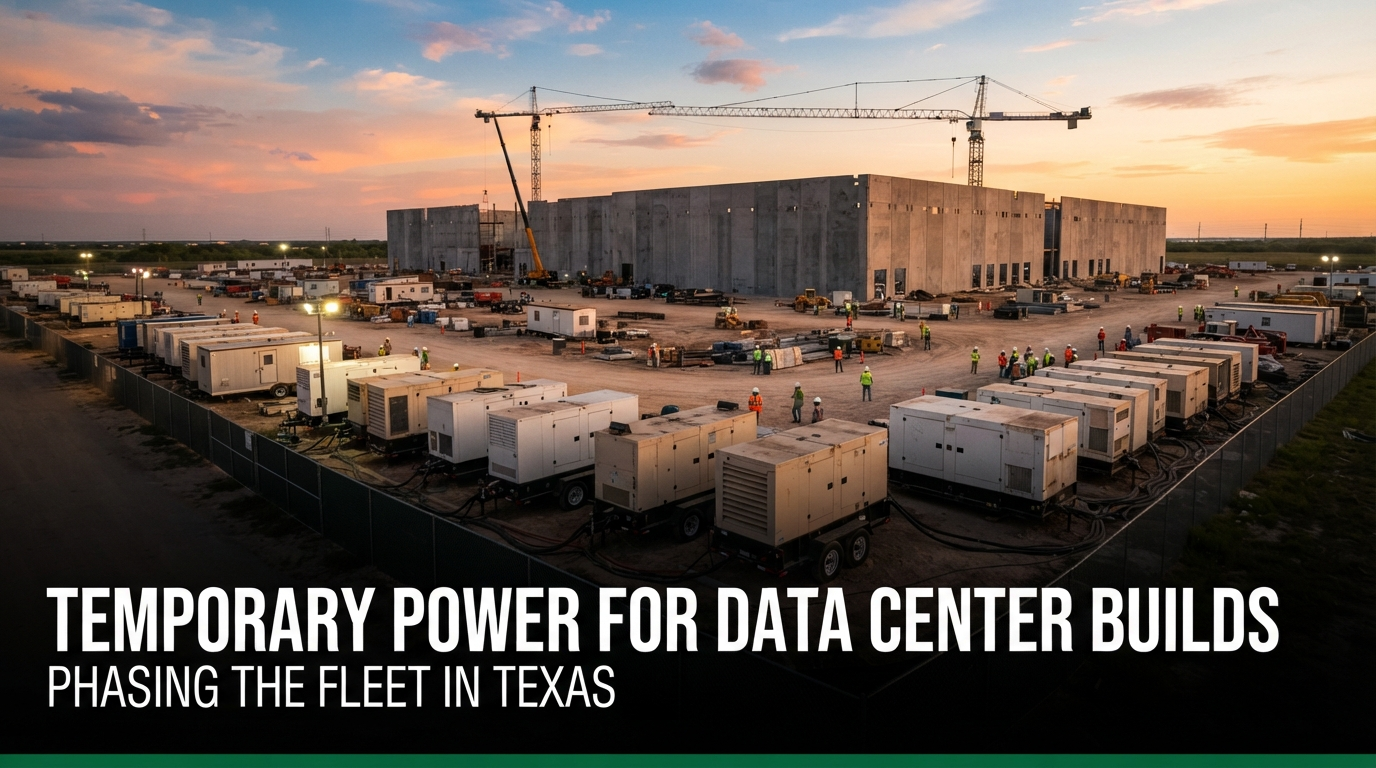
Data center construction sites in Texas typically need megawatt-scale temporary power for 18 to 36 months before the permanent utility service and the building’s own standby generators are energized. That gap is the rental window, and it covers site prep, concrete, mechanical fit-out, and commissioning.
Key Takeaways
- The build phase and the finished facility need completely different power. Rental gensets carry the construction load. The permanent 2 MW to 3 MW standby units arrive late and are commissioned, not used for construction.
- ERCOT expects Texas electricity demand to rise 7% in 2025 and 14% in 2026 as large data centers come online, according to the U.S. Energy Information Administration.
- Utility interconnection is the long pole. Temporary power gets the trades working while the permanent service waits in queue.
- Commissioning is the peak load moment, not the construction peak. Load testing the finished electrical rooms can demand more temporary capacity than the entire framing phase.
- Every 120-volt, 15- and 20-ampere receptacle on the site needs GFCI protection under OSHA 1926.404.
- Phased power beats one oversized unit. Load grows in steps across a data center build, and the rental fleet should step with it.
Why Data Center Builds Are a Different Power Problem
Most construction sites have one power curve. It rises through structure and fit-out, then falls off at closeout. A data center build has three distinct curves stacked on top of each other, and each one wants different equipment.
The site work phase is heavy equipment and light trailers. The shell and mechanical phase is welding, lifts, and dust collection. Then commissioning arrives, and the electrical contractor needs to energize switchgear, run UPS battery tests, and prove the mechanical plant, sometimes before the utility service is live.
That third phase catches general contractors off guard. Teams size the rental fleet for framing and find themselves short by hundreds of kilowatts eighteen months later.
The Texas Timing Problem
The reason temporary power matters so much here is interconnection. Texas is absorbing more new large load than at any point in its history. ERCOT’s preliminary long-term forecast puts regional demand at 367,790 MW by 2032, against an all-time peak of 85,508 MW recorded on August 10, 2023, per ERCOT.
Large flexible loads, the category that includes data centers and crypto mining, were expected to consume 54 billion kilowatthours in 2025, up almost 60% from 2024 and roughly 10% of all ERCOT grid consumption, according to the EIA. Approved capacity for those loads sat at 5,479 MW and was projected to reach 9,500 MW by the end of 2025.
What that means on the ground is simple. Everyone is in line. The permanent service date is not fully under the developer’s control, and the schedule is.
Load by Build Phase
Here is how temporary power demand typically moves across a Texas data center project. Treat these as planning shapes rather than quotes, since hall count and mechanical design drive the real numbers.
| Build phase | Typical duration | What draws power | Fleet shape |
|---|---|---|---|
| Site prep and civil | 2 to 4 months | Office trailers, security, dewatering, survey | Small units, one or two trailers, site lighting for early and late shifts |
| Shell and structure | 4 to 8 months | Welding, lifts, compressors, tower cranes | Mid-size units, distribution spread across the pad |
| Mechanical and electrical fit-out | 6 to 12 months | Pipe fitting, cable pulling, temp HVAC, dehumidification | Largest sustained draw, often parallel units |
| Commissioning and load testing | 2 to 6 months | Switchgear energization, UPS testing, mechanical proving | Highest peak, shortest duration, tight uptime requirement |
| Closeout | 1 to 2 months | Punch list, cleaning, final inspections | Fleet steps back down |
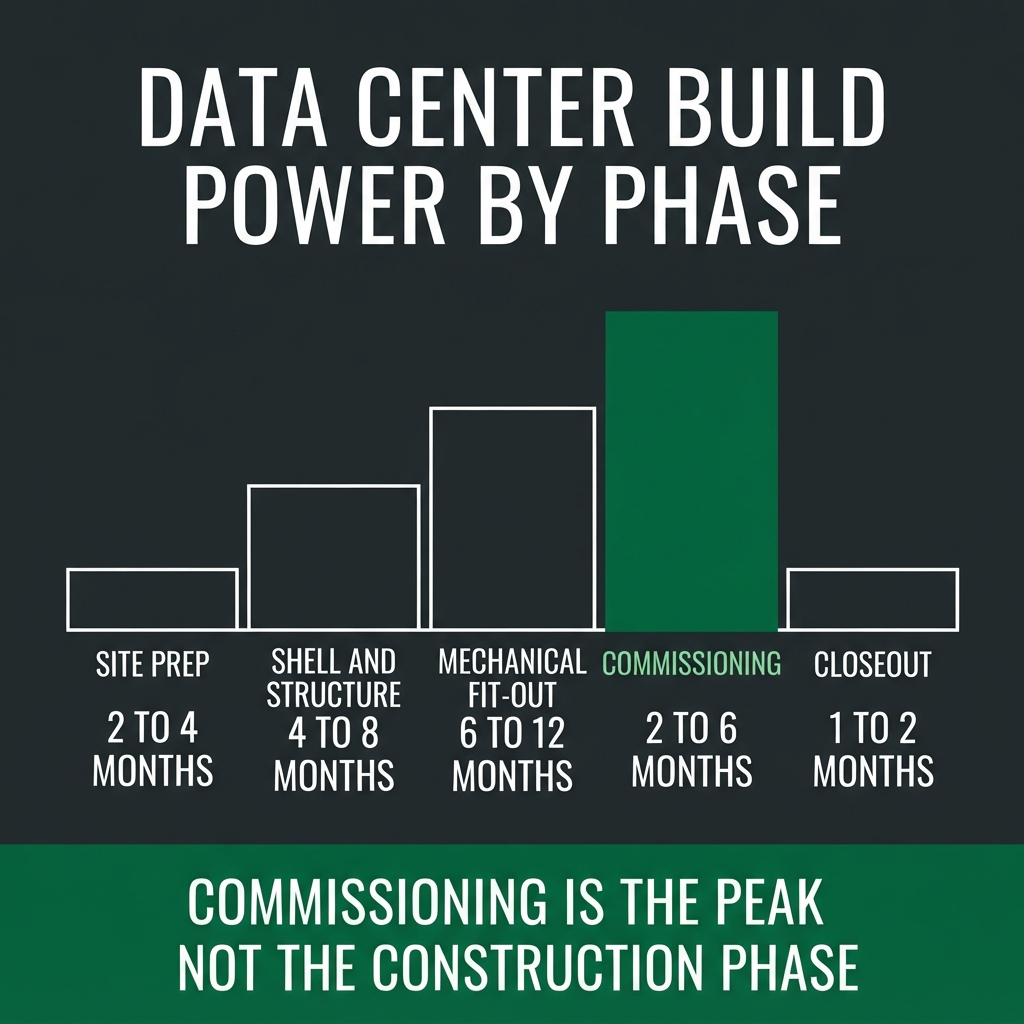
The pattern worth noticing is that the fleet should shrink and grow. Renting one unit sized for the commissioning peak and running it through eighteen months of light site work means paying for capacity nobody uses and running an engine at a load factor that is bad for it. Our generator sizing guide covers the load math for a single phase in more detail.
Why Oversizing Hurts More Here Than Elsewhere
A diesel engine wants load. Run one at 20% of its rating for months and unburned fuel accumulates in the exhaust system, a condition called wet stacking that degrades performance and shortens service life.
On a short project the exposure is limited. On a 24-month data center build with a fleet that was sized for the peak on day one, it is a real maintenance liability. The fix is phasing, and it is the single biggest cost lever on a long build. We covered the economics of this in our piece on why oversizing costs you money.
Phasing also changes the fuel conversation. A right-sized unit at a healthy load factor burns less per useful kilowatt-hour than an oversized one loafing, which matters when the site is consuming fuel for two years straight. Our guide to fuel management and delivery walks through how deliveries get scheduled on long-running sites.
Commissioning: The Phase That Breaks Schedules
Commissioning is where temporary power stops being a convenience and becomes a schedule dependency.
The electrical contractor needs stable, clean power to energize switchgear and prove the distribution. The mechanical contractor needs to run chillers and CRAC units under load. Integrated systems testing wants the whole plant exercised at once. And in many builds, at least part of this happens before the permanent utility feed is fully in service.
Three things matter at this stage:
- Capacity headroom. Testing pulls loads that never occurred during construction.
- Voltage and frequency stability. Sensitive electrical equipment being commissioned is unforgiving of a wandering source.
- Uptime. A generator failure during an integrated test does not just pause work, it can invalidate the test.
This is the moment where a managed rental relationship earns its keep, because a unit that fails at 2 a.m. during a commissioning window needs a technician, not a phone tree.
Site Safety and Code on a Data Center Build
The volume of temporary electrical infrastructure on these sites is unusual, which raises the compliance stakes.
OSHA requires that all 120-volt, single-phase, 15- and 20-ampere receptacle outlets on construction sites that are not part of the permanent wiring have approved ground-fault circuit interrupters for personnel protection, under 1926.404(b)(1)(ii). Where a contractor uses the assured equipment grounding conductor program instead, cord sets and receptacles must be tested at intervals not exceeding 3 months, or 6 months for fixed equipment not exposed to damage.
Temporary wiring itself has rules that get overlooked on long builds. Under 1926.405(a)(2), feeders must originate in a distribution center, branch-circuit conductors may not be laid on the floor, open conductors must be fastened at intervals not exceeding 10 feet, and temporary wiring above 600 volts requires fencing or barriers limiting access to qualified personnel.
Two years is long enough for a temporary installation to start feeling permanent. It is not, and inspectors know the difference.
What to Ask a Rental Partner Before You Sign
- Can the fleet be stepped up and down as phases change, without renegotiating from scratch?
- Who owns fuel, and how are deliveries scheduled against a two-year draw?
- What is the response time on a failure during a commissioning window?
- Are units emissions-compliant for the county and does the paperwork come with them?
- Can you support parallel operation if a single unit will not cover the commissioning peak? Our overview of parallel generator systems explains when that makes sense.
- Does the plan include temporary climate control for the fit-out phase, when humidity control becomes a schedule item?
If a rental company cannot answer the phasing question, they are selling equipment, not managing a build.
Planning Your Project’s Temporary Power
Data center construction in Texas is not slowing down, and neither is the pressure on schedules. The projects that stay on track are the ones that treated temporary power as a phased program from preconstruction rather than a line item someone handled after mobilization.
We work with contractors across Austin, Dallas, San Antonio, Fort Worth, and Waco on exactly this problem, matching fleet size to build phase and handling delivery, fuel, and maintenance so the schedule is not waiting on a generator. If you have a build coming up, get in touch and we will walk the phases with you before you mobilize.
Frequently Asked Questions
What generators do data centers use?
Finished data centers use permanent standby diesel or natural gas gensets, commonly rated at or above 3 MW and deployed in N+1 or 2N redundant configurations. During construction, that permanent equipment is not yet available, so the site runs on rental units sized to the construction load and scaled by phase.
How much temporary power does a data center construction site need?
It varies by phase rather than by a single number. Site prep may need a few hundred kilowatts across trailers and lighting, while mechanical fit-out and commissioning can demand an order of magnitude more. The right approach is to model each phase separately and plan a fleet that changes with the schedule.
Can construction start before the permanent utility service is connected?
Yes, and on most Texas data center projects it does. Temporary generator power lets site work, structure, and much of the fit-out proceed while the permanent interconnection moves through its own timeline. Commissioning is where the two timelines finally have to meet.
Does the US have enough electricity for data centers?
Capacity and delivery are different questions. ERCOT projects regional demand reaching 367,790 MW by 2032 and is adding generation and transmission accordingly, but the practical constraint for a given project is interconnection timing rather than statewide supply. That timing gap is exactly what temporary power bridges.
Sources
- U.S. Energy Information Administration: We expect rapid electricity demand growth in Texas and the mid-Atlantic
- U.S. Energy Information Administration: Data centers and cryptocurrency mining in Texas drive strong power demand growth
- ERCOT: Preliminary Long-Term Load Forecast for 2026-2032
- OSHA 1926.404: Wiring design and protection
- OSHA 1926.405: Wiring methods, components, and equipment for general use