
Undersizing a generator on a job site doesn’t just trip a breaker; it shuts down your entire crew. Oversizing costs you fuel, rental budget, and logistics headaches you don’t need. Getting the size right the first time starts with a load calculation, and that’s exactly what this guide walks you through.
In this article:
- The difference between running watts and starting watts, and why it determines your minimum generator size
- A step-by-step method for calculating total site load
- A wattage reference table for common construction tools
- How demand factor keeps you from over-ordering
- Texas-specific considerations that change your numbers
- When the calculation is more than a one-person job
Whether you’re pulling power for a two-crew framing job or a full oil and gas pad site, this process gives you a defensible number before you call for equipment.
Running Watts vs. Starting Watts: What’s the Difference?
Every electric motor on your job site has two power draws: the steady load it pulls while running, and the surge it demands the instant it starts. Running watts is the continuous draw. Starting watts (also called surge watts or inrush current) is the spike, and for motors, that spike is typically 2x to 6x the running load for one to three seconds.
This distinction matters because generators are rated by their continuous output capacity, not their surge capacity. If your generator can’t absorb the starting surge of your largest motor, it will stall or trip under load, usually at the worst possible moment.
A practical example: A 1 HP air compressor with a capacitor-start motor draws roughly 1,200 watts running but can demand up to 3,600 watts to start. If your generator is sized only for the running load, the first time that compressor kicks on under pressure, you’re going to have a problem.
The rule: always identify the highest starting-wattage item on your site. That single item often sets your floor for generator sizing.
Key takeaway: Running watts tells you what you need to sustain. Starting watts tells you what you need to survive the first few seconds. Your generator must handle both, size to the surge, not the steady state.
Step-by-Step: How to Calculate Your Generator Size
This is a four-step process. Do it in order.
Step 1 – List Every Load on Site
Write down every piece of electrical equipment that will run simultaneously. Include power tools, lighting, HVAC units in mobile offices, battery chargers, and any temporary panel feeds.
Step 2 – Assign Running and Starting Watts
Use the nameplate data on each tool or the reference table below. For motors without nameplate data, a conservative starting-watt multiplier is 3x running watts for capacitor-start motors and up to 6x for split-phase motors.
Step 3 – Calculate Total Running Load
Add up the running watts for every item you listed. This is your baseline continuous load.
Step 4 – Add the Largest Starting Load
Take the single largest starting wattage on your site and add it to the total running load. That sum is your minimum generator requirement before any safety factor.
Formula:
Required Generator Size = (Total Running Watts) + (Largest Starting Watts) × 1.25
The 1.25 multiplier is the 125% safety factor required for continuous loads under NEC Article 220. It also gives your generator room to breathe, running a diesel generator at or above its rated load continuously shortens engine life and increases fuel consumption.
Generator Size Calculator
Add your equipment loads to find the right generator size
Key takeaway: Don’t just add up running watts and call it done. The largest motor’s starting surge is the variable that most often causes undersized rentals to fail in the field.
Construction Tool Wattage Reference Table
Use this table as your starting point. Actual watts vary by manufacturer, motor type, and age of equipment, always check the nameplate when possible.
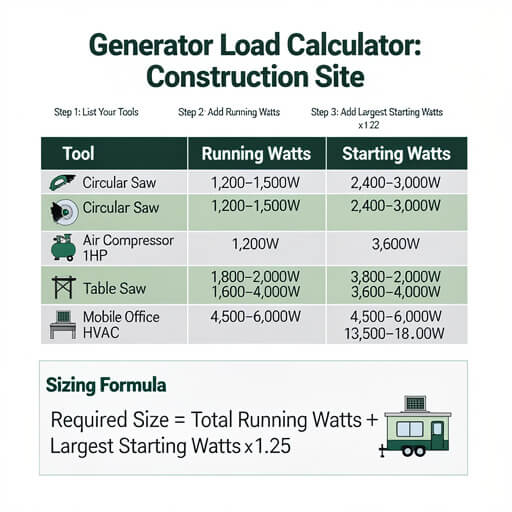
| Tool / Equipment | Running Watts | Starting Watts |
|---|---|---|
| Circular saw (7-1/4″) | 1,200–1,500 | 2,400–3,000 |
| Reciprocating saw | 960–1,200 | 1,920–2,400 |
| Angle grinder (4-1/2″) | 900–1,400 | 1,800–2,800 |
| Hammer drill | 600–900 | 1,200–1,800 |
| Rotary hammer (1-1/8″) | 1,000–1,500 | 2,000–3,000 |
| Table saw (10″) | 1,800–2,000 | 3,600–4,000 |
| Air compressor (1 HP) | 1,200 | 3,600 |
| Air compressor (2 HP) | 2,400 | 7,200 |
| Welder (stick, 200A) | 3,000–6,000 | N/A (resistive) |
| Concrete mixer (1/2 HP) | 400–750 | 1,200–2,250 |
| Submersible pump (1 HP) | 1,200 | 3,600 |
| Construction lighting (500W halogen) | 500 | 500 |
| LED light string (100 ft) | 100–200 | 100–200 |
| Mobile office HVAC (3-ton) | 4,500–6,000 | 13,500–18,000 |
| Electric heater (240V, 5kW) | 5,000 | 5,000 |
Key takeaway: HVAC equipment in temporary trailers and mobile offices carries the heaviest starting load of anything on most job sites. If you’re powering a mobile office or site trailer, add that HVAC starting load to your calculation before anything else.
Demand Factor – Why You Don’t Need to Add Everything Up
Here’s where most site managers over-order: they add up every tool and every circuit at full load simultaneously. In reality, not every tool runs at the same time.
Demand factor is the ratio of the actual maximum load to the total connected load. Under NEC Article 220, a demand factor of 0.75 (75%) applies to four or more fixed appliances, meaning you can legitimately reduce your connected load calculation before sizing your generator.
How to apply it on a job site:
- Separate your load list into continuous loads (lighting, HVAC, power to a panel) and intermittent loads (hand tools, pumps).
- Apply full load to everything continuous.
- Apply a 0.75–0.80 demand factor to the intermittent tool load, recognizing that not every saw and drill runs simultaneously at full draw.
- Still add the full starting watts of the single largest motor, demand factor does not reduce the starting surge calculation.
Example: A five-person framing crew with five circular saws, one air compressor, and two work lights:
- Running: (5 × 1,400) + 1,200 + 400 = 8,600W
- Apply 0.80 demand factor to tool loads: 8,600 × 0.80 = 6,880W
- Add largest starting load (air compressor at 3,600W): 6,880 + 3,600 = 10,480W
- Apply 1.25 safety factor: 10,480 × 1.25 = 13,100W minimum
That crew needs at minimum a 15 kW generator. Without the demand factor, the unadjusted total would have pushed to 17+ kW, and a 20 kW unit, potentially an unnecessary step up.
For a deeper look at how this connects to your construction site power guide, that resource covers fuel planning, delivery logistics, and multi-generator setups for larger sites.
Key takeaway: Demand factor is not a shortcut, it’s a code-recognized methodology that prevents over-ordering while keeping your calculation defensible. Use it on intermittent loads, never on continuous loads or motor starting surges.
Texas-Specific Considerations
If you’re running a job site in Texas, two environmental factors affect your generator’s real-world output: ambient temperature and, in some West Texas locations, altitude.
Heat Derating
Diesel generators are rated at ISO standard conditions: 77°F (25°C) ambient temperature. In a Texas summer, ambient temps at the engine intake on a job site can reach 100°F to 110°F. Every 18°F (10°C) above the rated temperature reduces generator output by approximately 1%. At 107°F, that’s a 1.5–2% derating, manageable, but enough to matter if you’re already pushing the rated load.
Practical rule for Texas summers: Add a 5–8% buffer to your calculated load, or discuss engine derating with your generator rental provider before confirming equipment size.
Altitude Derating
For most of the Texas Triangle, Austin, Dallas, San Antonio, Fort Worth, Waco, altitude is not a factor. Elevations under 3,000 feet have negligible impact on diesel generator output. Far West Texas and the Trans-Pecos region (above 3,000 ft) may require altitude derating at approximately 3% per 1,000 feet above 3,300 feet.
For generator rental in Dallas and central Texas metro sites, heat derating is your primary variable. Altitude can be ignored below 3,000 feet.
Key takeaway: In Texas, assume your generator delivers 95–97% of its rated output on a peak summer day. Build that into your sizing calculation before you confirm your rental, especially for long-duration projects running continuous loads.
When to Call a Professional Instead of Sizing Yourself
The four-step load calculation above handles the majority of construction job sites accurately. But there are specific situations where a manual estimate isn’t enough.
Get a professional load analysis when:
- Your site includes variable-frequency drives (VFDs), large welding banks, or motor control centers
- You’re powering a full temporary distribution panel with multiple branch circuits
- The project spans more than 90 days with load changes as phases progress
- You’re in an oil and gas environment where power interruptions create safety events, not just productivity loss
- You need OSHA 29 CFR 1926 Subpart K compliance documentation, required for all construction sites under federal OSHA jurisdiction
OSHA’s Subpart K electrical standards apply to all temporary and permanent electrical installations on construction jobsites. Improper sizing that leads to overloaded circuits, failed grounding, or inadequate protection is a compliance issue, not just a mechanical one.
If you’re unsure whether your load list is complete or your site has unusual equipment, review the common generator sizing mistakes that site managers most often make before finalizing your order. Understanding what not to do is just as useful as the calculation itself.
JC Davis Power provides equipment delivery, fueling, and on-site maintenance across Texas, including Austin, Dallas, San Antonio, Fort Worth, and Waco. View the full range of services to understand what’s included in a rental, or contact the team to have a sizing conversation before you commit to a unit.
Key takeaway: A manual load calculation is sufficient for most job sites. When the site involves complex motor loads, long project timelines, or OSHA documentation requirements, a professional assessment protects the project, and the crew.
Frequently Asked Questions
What size generator do I need for a 5-person construction crew?
A five-person crew running power tools, an air compressor, and work lighting typically needs between 12 kW and 20 kW, depending on which tools run simultaneously and whether any climate-controlled trailers or mobile offices are on site. Use the step-by-step calculation above with your specific tool list for an accurate number. A 15 kW diesel generator covers most mid-size framing and finish crews without over-provisioning.
What is a generator wattage calculator and how do I use it?
A generator wattage calculator is a tool that adds up the running watts and starting watts of all your equipment to find your minimum generator size. To use one accurately, you need the running wattage and starting wattage of each item from the nameplate or manufacturer spec, your demand factor for intermittent loads, and your continuous-load safety factor (NEC Article 220 requires 1.25x for continuous loads). This article’s four-step method gives you the same result without relying on a generic online tool.
Does heat affect how much power a generator produces in Texas?
Yes. Diesel generators derate in high ambient temperatures. At 107°F, a realistic peak for a Texas summer job site, expect output to drop by roughly 1.5–2% compared to the rated capacity. For a 20 kW generator, that’s roughly 300–400 watts of lost capacity. Add a 5–8% buffer to your calculation for summer projects in Texas to account for this.
What is the difference between kW and kVA on a generator spec sheet?
kW (kilowatts) is real power, what your loads actually consume. kVA (kilovolt-amperes) is apparent power, which includes reactive load from motors and transformers. Most construction tools and equipment operate at a power factor between 0.8 and 1.0. To convert: kW = kVA × power factor. If a generator is rated at 25 kVA at 0.8 power factor, its real output is 20 kW. Always confirm which figure you’re comparing when evaluating rental specs.
Get the Right Generator for Your Site
Knowing what size generator you need is step one. Having a reliable rental partner who delivers, fuels, and maintains the unit, so you can stay focused on the project, is step two.
JC Davis Power serves construction, oil and gas, medical, and education sites across Texas. Rentals include fuel delivery, on-site maintenance, and mobile office power for complete temporary power solutions.
Contact JC Davis Power to discuss your load requirements and confirm the right generator size for your next project.
External Sources
- U.S. Department of Labor – OSHA 29 CFR 1926.402, Electrical Standards for Construction (Subpart K): https://www.osha.gov/laws-regs/regulations/standardnumber/1926/1926.402
- Kopperfield – NEC Article 220: A Quick Guide for Load Calculations: https://www.kopperfield.com/blog/nec-article-220
- EC&M (Electrical Construction & Maintenance) – NEC Requirements for Generators: https://www.ecmweb.com/national-electrical-code/code-basics/article/21273030/nec-requirements-for-generators