
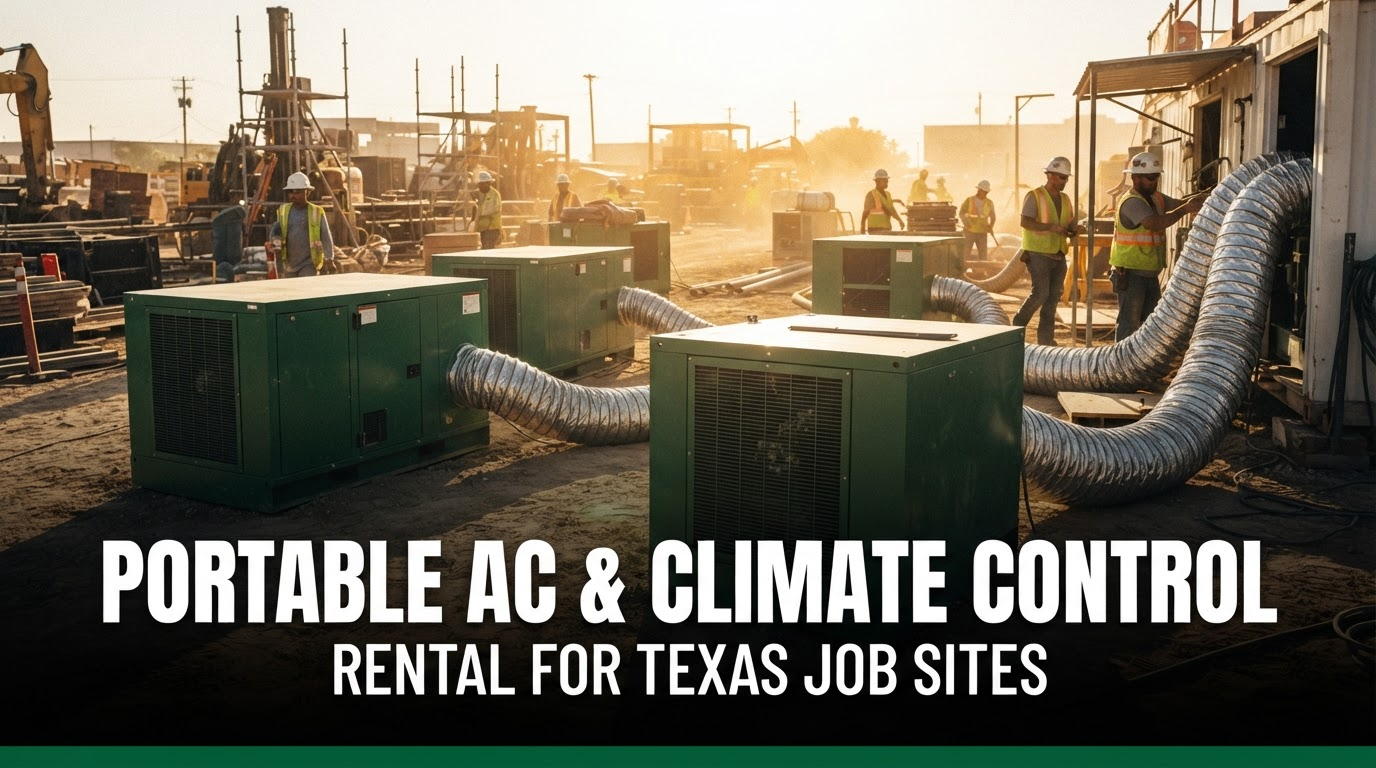
When Texas heat pushes past 100°F, cooling is no longer a comfort. It becomes a safety and schedule problem. Portable AC and temporary climate control rental keep crews working. They also protect heat-sensitive materials and hold equipment rooms in spec, with no wait for permanent HVAC. This guide shows you how to size cooling by BTU and tonnage. It also covers which equipment fits your space and what drives the cost. JC Davis Power’s temporary climate control rental covers cooling, heating, and dehumidification on one flat-rate rental across Texas.
In this article:
- How to size portable cooling by BTU and tonnage, before you call for equipment
- Which type of unit fits your space: spot cooler, self-contained HVAC, or chiller
- What temporary climate control costs in Texas and the factors that move the number
- Why cooling equipment sizing depends on your power supply
- When crew heat safety turns cooling from optional into required
What Is Temporary Climate Control?
Key takeaway: Temporary climate control is rented cooling, heating, and dehumidification gear. You size it to the space, run it for the job, and send it back when you’re done.
Temporary climate control is a rental service. It delivers portable cooling, heating, and moisture control to a job site with no permanent install. The equipment ranges from portable spot coolers to self-contained HVAC units to industrial chillers rated from 50 to 500-plus tons. The point is to condition a space on your timeline, not the building’s. You can cool a data closet during a summer buildout. You can dry out a flooded storage area. You can keep a mobile classroom comfortable through August, then send the gear back.
On a Texas job site, the most common request is cooling. But the same rental model handles heating for a winter pour and dehumidification for humid Gulf Coast storage. Matching the right equipment to the season is where a dedicated climate control provider earns its keep.
Now that the category is clear, the first real decision is how much cooling you actually need.
How to Size Portable Cooling: BTU and Tonnage Explained
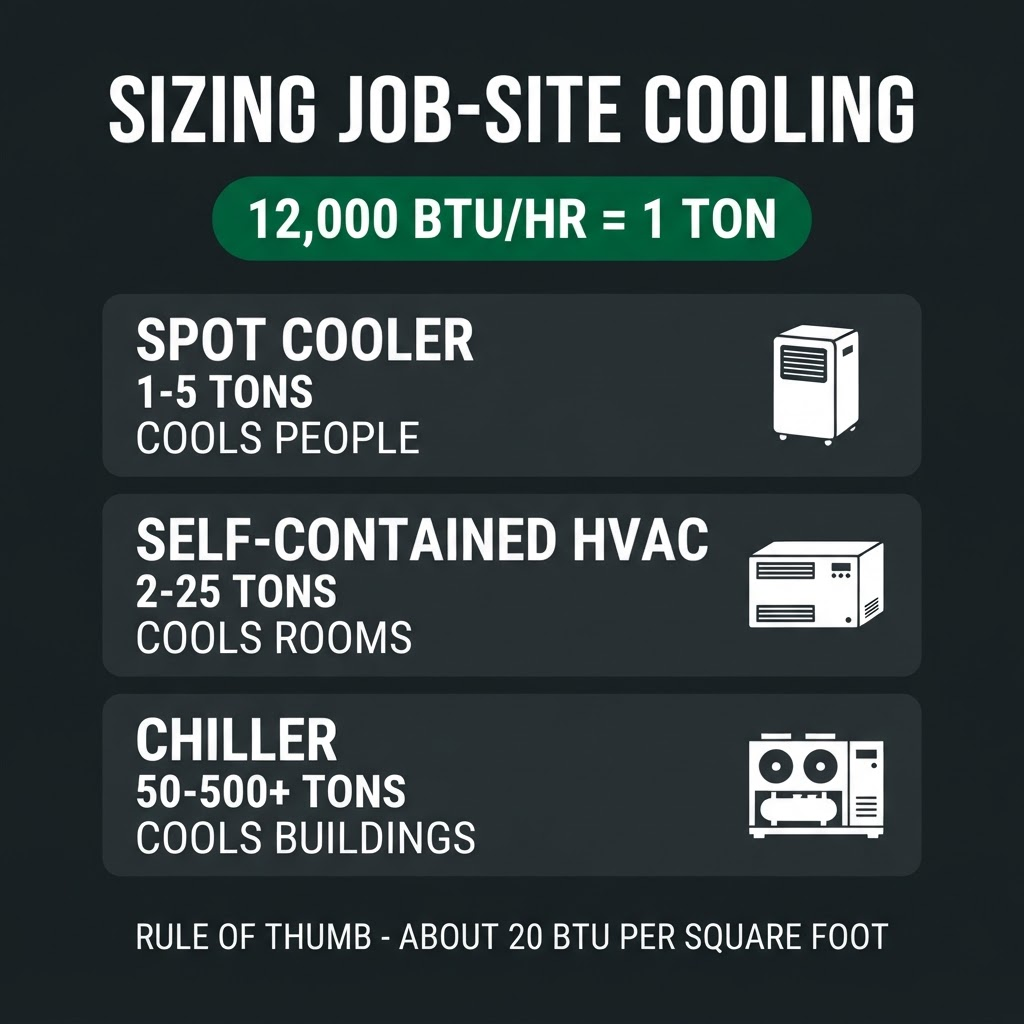
Key takeaway: Cooling capacity is measured in BTUs per hour. And 12,000 BTU/hr equals one ton. The two units measure the same thing at different scales.
A BTU (British Thermal Unit) is the energy needed to raise one pound of water by one degree Fahrenheit. Cooling equipment is rated in BTUs per hour, and one ton of cooling equals 12,000 BTU/hr. So a 5-ton unit delivers 60,000 BTU/hr. Federal ENERGY STAR sizing guidance uses the same BTU-per-hour rating to match cooling to a space. This lets you compare a consumer-style portable AC rated in BTUs against an industrial unit rated in tons.
For a rough start, a well-insulated indoor space needs about 20 BTU per square foot. A 1,000-square-foot area needs around 20,000 BTU/hr. That is just under 2 tons, before you add anything that gives off heat.
Several factors push that number up on a real job site:
| Heat Load Factor | Effect on Cooling Needed |
|---|---|
| Direct sun / poor insulation | +10-30% |
| Occupancy (each worker adds heat) | +600 BTU/hr per person |
| Running equipment / electronics | Add nameplate heat output |
| High ceilings or open bays | Size by volume, not floor area |
| Texas ambient over 100°F | Equipment derates; add buffer |
The lesson: floor area gets you a ballpark, but sun exposure, headcount, and heat-generating equipment are what actually set the tonnage. For enclosed equipment rooms and process areas, the heat thrown off by the machines usually matters more than the room’s square footage.
That covers how much cooling, next is what kind of unit delivers it.
Spot Cooler vs. Self-Contained HVAC vs. Chiller
Key takeaway: Spot coolers cool people and small zones. Self-contained HVAC units cool enclosed rooms. Chillers handle large or multi-zone loads through air handlers.
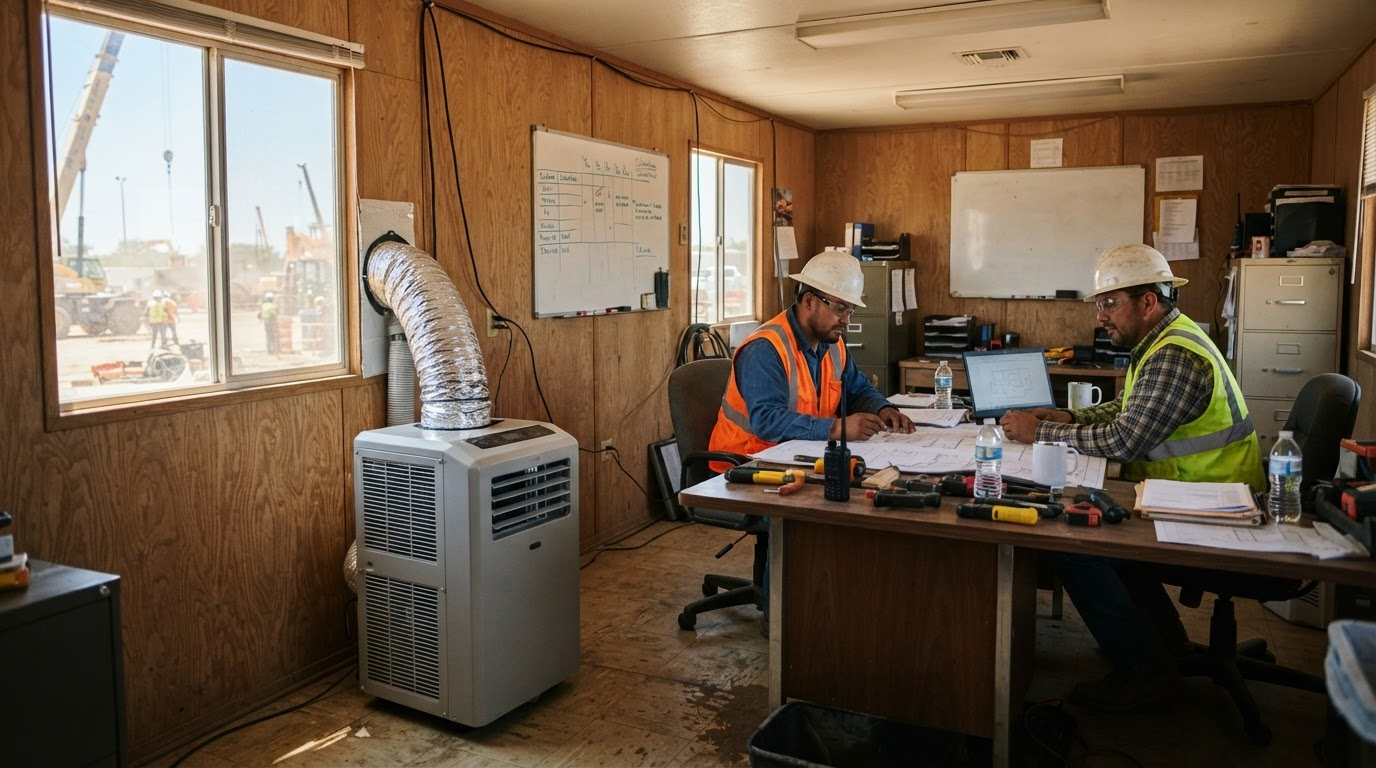
Choosing the wrong category is the most common and most expensive sizing mistake. A spot cooler is a portable unit that blows cold air right at a person or workstation. It is ideal for targeted relief in an open bay, where cooling the whole space would be wasteful. A self-contained HVAC unit conditions an entire enclosed space, such as a mobile office, equipment room, or trailer. It manages both temperature and humidity. A chiller makes chilled water that feeds one or more air handling units (AHUs). That is how you cool large square footage or several zones at once.
Here’s the quick decision rule: cool the person with a spot cooler, cool the room with self-contained HVAC, and cool the building with a chiller-and-AHU setup.
| Equipment | Best For | Typical Capacity | Cools |
|---|---|---|---|
| Spot cooler | Targeted relief, open areas | 1-5 tons | People / small zones |
| Self-contained HVAC | Enclosed rooms, trailers | 2-25 tons | Whole enclosed space |
| Chiller + AHU | Large or multi-zone sites | 50-500+ tons | Buildings / process loads |
Match the equipment to the job and you avoid two failure modes at once: a unit too small to hold temperature, and an oversized rental you’re paying for every month. A climate expert assigned to your account can right-size this before delivery.
Once you know the equipment, the next question is almost always about power.
Cooling Equipment Depends on Your Power Supply
Key takeaway: Portable AC and chillers carry some of the heaviest starting loads on a job site. So you size the generator to fit the cooling equipment, not the other way around.
Climate control equipment runs on electricity. HVAC compressors demand a big surge of power the instant they start, often three to four times their running draw. If your site runs on temporary power, build the cooling load into your generator sizing from the start. Skip that step, and the first time a 10-ton unit kicks on it can stall an undersized generator. That can take your other equipment down with it.
This is where climate control and power planning connect. First, work through your generator sizing calculation before you confirm a cooling rental for an off-grid site. Add the HVAC starting load first, since it is usually the largest surge on the site. Generators also lose output in extreme heat. Our guide to managing generator performance in 100°F Texas weather explains the derating you should plan around.
Renting cooling and power from one provider means both are sized together, delivered together, and monitored together, which brings us to cost.
What Temporary Climate Control Costs in Texas
Key takeaway: Climate control rental is priced by tonnage, rental length, and what’s bundled in. There is no single flat sticker price.
There is no one price for temporary cooling. A 2-ton spot cooler and a 300-ton chiller are different machines for different jobs. The real cost drivers are tonnage, how long you need it, and what’s included in the rate. That last point matters most. A low equipment-only quote can cost more once you add delivery, rigging, setup, fuel, and pickup on top.
Factors that move the number:
- Equipment size and type, tonnage is the biggest single driver
- Rental duration, monthly rates lower the effective daily cost on long jobs
- Delivery, rigging, and setup, larger chillers need equipment to place
- Fuel and power, if the unit or its generator burns diesel
- Monitoring and service, 24/7 support and rapid-response callouts
JC Davis Power rentals are structured as an all-inclusive flat monthly rate that bundles delivery, installation, maintenance, and pickup, so the quoted number is the number. To get a real figure for your space and duration, request a quote with your square footage, heat load, and timeline.
Cost aside, there are situations where cooling isn’t a budget decision at all, it’s a safety requirement.
When Cooling Becomes a Safety Requirement
Key takeaway: Federal law requires employers to protect workers from known hazards, including extreme heat. In a Texas summer, that makes job-site cooling a compliance issue, not just a comfort one.
Heat is one of the most serious hazards on a Texas job site. It also carries a legal weight many managers underestimate. OSHA does not have a single numbered heat standard. Instead, it enforces heat-illness protection under the General Duty Clause, Section 5(a)(1) of the OSH Act. That clause requires employers to keep workplaces free of known hazards likely to cause serious harm. In practice, that means shade, water, and rest. In enclosed or high-heat areas, active cooling can be part of a heat-illness prevention program too.
Indoor and enclosed spaces are the hardest cases, equipment rooms, trailers, and tented work areas. There, mechanical cooling is often the only way to reach a safe temperature. Right-sized climate control protects the crew and the schedule at once. A heat-stopped crew costs you the same lost day an equipment failure would.
That connects the whole picture: sizing, equipment, power, and cost all serve one goal, keeping the job moving safely through the Texas heat.
Frequently Asked Questions
How much portable AC do I need for a construction trailer?
A typical single-wide construction trailer of about 800 square feet needs roughly 2 to 3 tons of cooling (24,000-36,000 BTU/hr) in a Texas summer. That accounts for sun exposure and the people and electronics inside. A self-contained HVAC unit is usually the right fit for an enclosed trailer, since it manages humidity along with temperature. Confirm the number against your actual square footage, insulation, and headcount before renting.
What’s the difference between a spot cooler and a portable air conditioner?
A spot cooler is a type of portable air conditioner built to blow cold air directly at a person or a small work area rather than condition an entire room. It’s designed for targeted relief in open or hard-to-cool spaces, like a large bay or a warehouse aisle. A full portable HVAC unit, by contrast, is sized to cool and dehumidify a whole enclosed space.
How many BTUs are in a ton of cooling?
One ton of cooling equals 12,000 BTU per hour. So a 5-ton unit provides 60,000 BTU/hr and a 10-ton unit provides 120,000 BTU/hr. The “ton” comes from the amount of heat needed to melt one ton of ice in 24 hours, and it’s the standard way industrial and commercial cooling equipment is rated.
Can I run a portable AC unit off a generator?
Yes, but the generator has to be sized for the air conditioner’s starting surge, which can be three to four times its running wattage. On a temporary-power site, add the largest cooling unit’s starting load to your generator calculation first, because it’s usually the biggest single surge on the job. Renting the cooling and the generator from one provider ensures both are sized to work together.
Does JC Davis Power rent heating and dehumidification too?
Yes. Alongside cooling, JC Davis Power rents self-contained heating units and high-capacity dehumidifiers for moisture control in cold or humid conditions. The same flat-rate rental model, delivery, setup, maintenance, monitoring, and pickup included, applies across cooling, heating, and dehumidification.
Keep Your Crew Cool and Your Schedule On Track
Texas heat is predictable, and so is its effect on an unprepared job site: slowed crews, heat-sensitive materials at risk, and equipment rooms drifting out of spec. Right-sized temporary climate control removes that variable.
JC Davis Power delivers cooling, heating, and dehumidification across Texas, Austin, Dallas, Fort Worth, San Antonio, and Waco, on an all-inclusive flat monthly rate with 24/7 monitoring and rapid-response technicians. Contact JC Davis Power with your square footage, heat load, and timeline to size the right climate control for your site.
Sources
- U.S. Department of Labor, OSHA, Heat Illness Prevention: https://www.osha.gov/heat
- U.S. Department of Labor, OSH Act of 1970, Section 5 (General Duty Clause): https://www.osha.gov/laws-regs/oshact/section5-duties
- U.S. EPA / DOE, ENERGY STAR, Room Air Conditioners (sizing and capacity): https://www.energystar.gov/products/room_air_conditioners