
Key Takeaways
- A light tower generator is a mobile diesel unit with a telescoping mast, usually 23 to 30 feet tall, holding 4 to 6 LED or metal halide fixtures.
- Most units produce between 3,000 and 8,000 watts. Spare capacity runs tools through built-in 120V and 240V outlets.
- OSHA requires a minimum of 5 foot-candles of light on general construction areas. That standard, not guesswork, sets how many towers you need.
- Coverage depends on mast height, lumen output, and terrain, not wattage alone. A taller mast spreads light over more ground.
- LED towers sip fuel and run 220-plus hours on a single tank.
- On Texas job sites, heat and dust make runtime and cooling the specs that actually matter.
A light tower generator combines high-output lighting with exportable power in one towable machine. It raises a mast, throws light across a work area, and runs tools from outlets on the frame. Below is how the parts work together and how much ground one unit really covers.
We light job sites across Texas, from Austin road projects to oil field pads near Midland. The questions are always the same: how does it work, and how many do I need. Here are straight answers.
What a Light Tower Generator Actually Is
A light tower generator is a self-contained unit that produces both light and electrical power from one diesel engine. The engine drives an alternator, which feeds the lamps and any tools you plug in. Everything mounts on a trailer you can tow to the site.
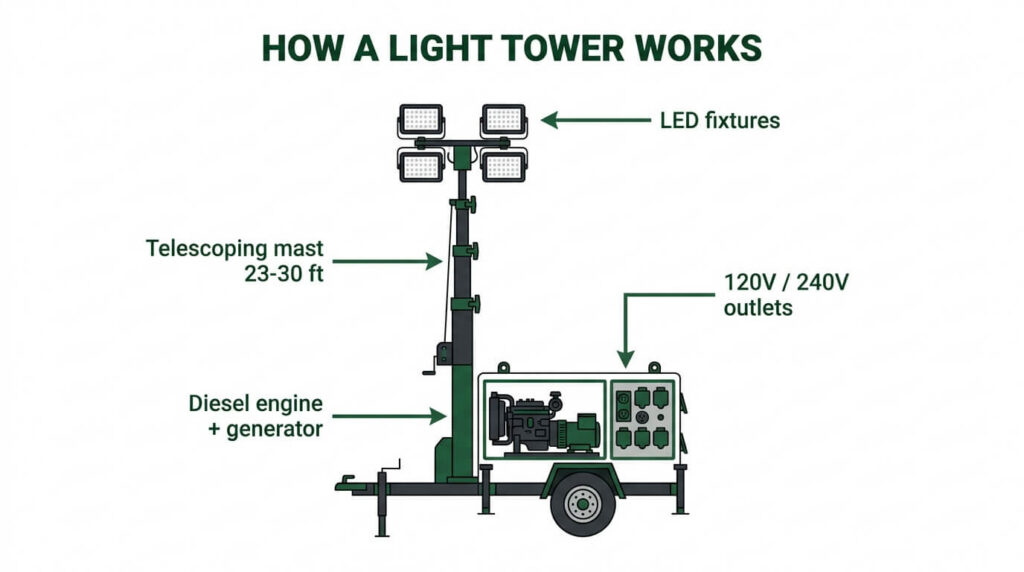
A standard unit has four main parts. The engine and generator head, the telescoping mast, the light fixtures, and the convenience outlets.
The mast is what sets a light tower apart from a plain generator. It raises the fixtures 23 to 30 feet up, so light spreads across the site instead of pooling at ground level. Most masts rotate a full 360 degrees.
That height is the whole point. Mount the same lamps at head level and you light a small circle. Raise them three stories and you cover a work zone.
How the Engine, Mast, and Lights Work Together
The diesel engine runs a generator head that produces 3,000 to 8,000 watts on most units. The lamps draw part of that output. Whatever’s left feeds the 120V and 240V outlets for saws, pumps, or a job trailer.
Here’s the sequence on a typical setup. You level the trailer, start the engine, and raise the mast with a manual, electric, or pneumatic winch. The fixtures power on, and the unit runs unattended for hours.
LED fixtures changed the math here. They throw more usable light per watt than older metal halide lamps, which means a smaller engine does the same job. Less fuel burned, longer runtime, fewer refuels.
Runtime is a real spec, not a footnote. Some LED units run 220-plus hours on one tank, so a crew isn’t stopping to fuel up every night. On a remote Texas pad far from a fuel stop, that’s the difference between working and waiting.
How Much Area Does One Light Tower Cover?
One 6 kW to 8 kW LED tower lights roughly 5,000 to 30,000 square feet of open ground, depending on mast height and lumen output. The wide range is the point: coverage is driven by how high the mast goes and how bright the fixtures are, not by engine wattage alone.
The honest answer is that “coverage” depends on how much light you legally need on the ground.
OSHA sets that floor. General construction areas need a minimum of 5 foot-candles, while excavation and general access areas need at least 3 foot-candles. A foot-candle is the light from one lumen spread over one square foot. Detailed tasks need more light, which shrinks the area one tower can cover to standard.
| Tower output | Rough coverage at standard light levels | Typical Texas use |
|---|---|---|
| 4 kW class | Up to ~10,000 sq ft | Small lots, security lighting, single work zone |
| 6–8 kW LED | ~15,000–30,000 sq ft | Road work, construction staging, event lots |
| Multiple linked towers | Acres | Large sites, 24/7 builds, oil field pads |
So the real question isn’t “how big is one tower’s circle.” It’s “how many foot-candles does this task need, and how many towers hit that across the whole site.” For a worked example by site size, our guide on how many light towers you need runs the numbers.
A taller mast also reduces glare and shadow. Two towers at 30 feet often beat four at 15 feet, because high-mounted light wraps around equipment instead of casting hard shadows behind it.
LED vs Metal Halide: Which Throws More Usable Light?
LED wins for most job sites today. LED fixtures hit full brightness instantly, survive vibration on a towed trailer, and produce more usable light per watt than metal halide. Metal halide still shows up on older rental units and costs less per lamp, but it warms up slowly and burns more fuel.
The gap matters most on long runs and rough roads.
| Feature | LED | Metal halide |
|---|---|---|
| Startup | Instant full brightness | 5–15 minute warm-up |
| Fuel use | Lower, longer runtime | Higher draw |
| Durability | Handles vibration well | Filaments fail on rough tows |
| Light quality | Crisp, even spread | Bright but more glare |
| Best for | Most modern job sites | Budget or short-term use |
For a Texas crew running overnight shifts in summer, LED’s fuel savings stack up fast. Fewer refuels also means less diesel hauled to a remote site. The same trade-offs show up across fuel and equipment choices, which we break down in our look at diesel versus other fuel types.
What Drives Light Tower Performance on Texas Sites
Heat and dust are the quiet killers of light tower uptime in Texas. A unit that runs fine in mild weather can struggle in 100-degree summer heat near San Antonio if it’s undersized or poorly maintained. Engine cooling and clean air filters matter more here than in cooler states.
Dust from caliche roads and oil field pads clogs filters faster, too.
Safety follows the same rule as any diesel engine. Refuel only after the engine cools, and keep the exhaust pointed away from any trench or confined space, since running engines still produce carbon monoxide that can pool in low spots.
This is why managed rentals hold up better on demanding sites. A maintained fleet gets serviced between jobs, so the unit that arrives is ready for a hard run. We see undersized, neglected towers fail on the third night of a 24/7 build, right when the crew needs them most. Our site lighting and light tower units are sized and serviced for that kind of Texas duty.
If you’re planning a build, road project, or oil field job and aren’t sure how many towers it takes to hit OSHA light levels, a short call sorts it out. Tell us the site size and the task, and we’ll spec the right number of units. Reach our team through the contact page for a straight recommendation.
Frequently Asked Questions
Q: How many watts does a light tower put out?
A: Most light tower generators produce between 3,000 and 8,000 watts. LED units need less to run the lamps, leaving more spare capacity for tools through the built-in outlets. Larger industrial towers can reach 15 kW to 20 kW.
Q: What is the coverage of a 4,000 watt light tower?
A: A 4 kW-class tower covers up to roughly 10,000 square feet of open ground at standard work-light levels. The exact area depends on mast height, fixture lumens, and how many foot-candles the task requires. Detailed work needs more light, so coverage shrinks.
Q: Will a light tower generator run a house?
A: It can power some circuits, but it isn’t built for it. Light tower generators are tuned for lamps and job site tools, and many have looser voltage regulation than a home standby unit. For building backup, a properly sized standby or mobile generator is the better tool.
Q: How long will a light tower run on one tank?
A: LED light towers commonly run 220-plus hours on a single tank, depending on fuel capacity and load. Metal halide units burn through fuel faster. Long runtime is a major reason LED towers dominate remote and overnight Texas jobs.