
Key Takeaways
- NEC Article 702.5 requires a transfer switch for any permanently installed standby generator, direct connection to a building’s wiring is a code violation in every jurisdiction
- A 30A hookup uses 10-gauge copper wire and a NEMA L14-30 twist-lock; a 50A hookup requires 6-gauge wire and a NEMA 14-50 connection, undersizing causes voltage drop and tripped breakers
- Conductors from the generator output to the first overcurrent device must be rated at 115% of the generator’s nameplate current (NEC Article 445), not 100%
- Under OSHA 29 CFR 1926.404(f)(3)(i), a rental generator’s frame can serve as the grounding electrode, but only when it’s not connected to a structure via a transfer switch
- Transfer switches must carry a UL 1008 listing; NEMA 3R rated enclosures are required for outdoor Texas installations
Hooking up a rental generator wrong doesn’t just fail inspection, it creates a backfeeding hazard that can kill a lineman working the street outside your site. The wiring side of generator rental is where most project managers lean on the rental provider for answers. Here’s what the code actually requires, so you’re not guessing.
What NEC Code Actually Governs Generator Wiring
Generator wiring falls under two National Electrical Code articles. Article 445 covers the generator itself. Article 702 covers optional standby systems, which is what most construction site and commercial temporary power setups are classified as.
The key rule in Article 445: conductors running from the generator’s output terminals to the first overcurrent protective device must be rated at no less than 115% of the nameplate current rating. Not 100%. That 15% buffer accounts for the continuous-duty nature of generator loads. A generator rated at 100 amps requires conductors sized for 115 amps minimum.
Article 702.5 is the one that mandates a transfer switch. Any permanently installed optional standby system must use a transfer switch to keep the utility source and the generator source physically separate. That requirement exists to prevent backfeeding, a condition where generator power flows back into the utility grid through the main panel, energizing lines that utility workers assume are dead.
For a broader look at how industry standards govern generator systems, our post on generator industry standards and EGSA guidelines covers how those standards have evolved.
Transfer Switch Options, and Why You Can’t Skip One
A transfer switch is a device that disconnects your facility from the utility grid before connecting it to a generator. It physically prevents both sources from being live at the same time.
There are two types. A manual transfer switch (MTS) requires someone on-site to physically flip the switch, response time is 5 to 15 minutes. An automatic transfer switch (ATS) detects the power outage and transfers automatically, typically in 10 to 30 seconds. For critical loads, medical trailers, data equipment, climate-controlled spaces, ATS is the only option that makes operational sense.
A third option is an interlock kit, which is a mechanical device installed on your main panel that prevents the generator and utility breakers from being on simultaneously. Interlock kits are code-compliant in most jurisdictions for portable generator hookups and cost significantly less than a dedicated transfer switch. They’re not a substitute for a full ATS on large or complex sites.
Cost comparison for Texas project managers:
| Connection Method | Equipment Cost | Professional Install | Circuit Capacity |
|---|---|---|---|
| Interlock Kit | $50–$150 | $300–$600 | Full panel |
| Manual Transfer Switch (MTS) | $200–$800 | $500–$1,500 | 6–16 circuits |
| Automatic Transfer Switch (ATS) | $1,000–$3,000 | $2,000–$5,000 | Full panel |

Source: Generator Vault 2026 Installation Guide; JC Davis Power transfer switch data
All transfer switches used on commercial and construction installations must carry a UL 1008 listing. For outdoor Texas sites, the enclosure must be NEMA 3R rated minimum, that rating covers rain and ice. Coastal sites near Corpus Christi or Beaumont should use NEMA 4X, which adds corrosion resistance.
Our full breakdown of automatic vs. manual transfer switch selection walks through the decision criteria by project type.
Wire Sizing and Conduit: The Numbers That Matter
Wire gauge is where most hookup errors happen. The two most common rental generator connection sizes are 30A and 50A, and each has specific requirements.
A 30A connection uses 10-gauge copper wire for runs up to 50 feet, a NEMA L14-30 twist-lock receptacle, and supports up to 7,500 watts. Four 10-gauge conductors run through ¾-inch conduit minimum.
A 50A connection requires 6-gauge wire, a NEMA 14-50 receptacle, and handles up to 12,500 watts. Four 6-gauge conductors need 1-inch conduit minimum. Using ¾-inch conduit with 6-gauge wire is a code violation and causes dangerous heat buildup.
For larger industrial generators, the 100 kW to 500 kW units common on Texas construction sites, conductor sizing follows the 115% nameplate rule from NEC 445 and typically requires a licensed electrician to calculate and install. These aren’t plug-and-play connections.
NFPA 110 adds two requirements for the connection between generator and transfer switch: flexible conduit sections are required (rigid conduit can’t absorb the generator’s vibration), and stranded wire must be used instead of solid wire for the same reason. Vibration stress cracks solid conductors over time.
When you rent a generator from us for Austin construction projects, our setup team handles the connection method and conduit routing as part of the installation, not as an add-on.
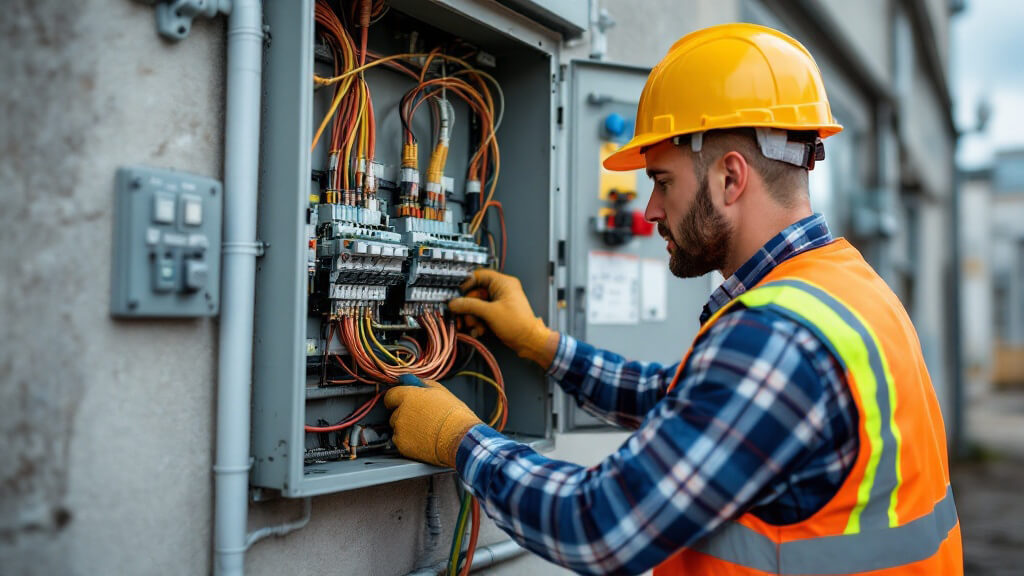
Grounding Requirements – What OSHA Says for Job Sites
Grounding rules for rental generators on construction sites differ from permanent installation rules, and the distinction matters.
Under OSHA 29 CFR 1926.404(f)(3)(i), a portable or rental generator’s frame can serve as the grounding electrode, meaning you don’t need a driven ground rod, when two conditions are met. First, the generator supplies only equipment mounted on the generator itself or cord-and-plug connected equipment. Second, all non-current-carrying metal parts are bonded to the generator frame.
That OSHA exception stops applying the moment you connect the generator to a structure through a transfer switch. At that point, the generator becomes part of a grounding system connected to the building, and NEC Article 250 takes over. A ground rod driven 8 feet into the earth and connected to the generator ground lug is required.
There’s a neutral bonding consideration too. When the transfer switch switches the neutral conductor, which most full-panel transfer switches do, the generator becomes a separately derived system under NEC Article 250.30. That triggers additional bonding requirements at the generator itself. Your electrician needs to verify whether your transfer switch is neutral-switching before finalizing the grounding design.
For Dallas generator rental projects, our team coordinates with the site electrician on grounding design before equipment arrives, not after.
Permits, GFCI, and What NFPA 110 Adds for Permanent Installations
Most Texas jurisdictions require an electrical permit for standby generator installations. The permit triggers an inspection, which means your wiring, transfer switch, and grounding must meet code before the system goes live.
For temporary construction site power that uses cord-and-plug connections rather than hard wiring, OSHA requires GFCI protection on all 120-volt, 15A and 20A receptacle outlets that aren’t part of the permanent building wiring. This applies to every temporary outlet, power strip, and extension cord distribution point on the site.
NFPA 110 adds requirements for Level 1 standby systems, the category that includes hospital backup power, emergency systems, and critical facilities. For these installations, generator room construction requires a two-hour fire resistance rating. The generator base must be raised at least 6 inches above floor or grade level to protect fuel and piping connections from flooding.
Most construction site rentals fall under Level 2 or optional standby classification, which carries less stringent room requirements. But if your project powers healthcare, data, or emergency services, confirm the classification with your electrician before the equipment order.
Our mobile office power generation setups across Texas include pre-configured transfer switch connections, compliant grounding, and documentation for permit inspections, standard, not optional.
If you’re working through the wiring and hookup side of a generator rental and need clarity on what your specific site and permit jurisdiction requires, reach out to our team. We’ve handled standby generator installation across Texas and can help you identify the right connection method before you’re in front of an inspector.
Frequently Asked Questions
Q: Do I need a permit to hook up a rental generator to my building?
A: Yes, in most Texas jurisdictions. Any hard-wired generator connection, including transfer switch installation, requires an electrical permit and inspection. Temporary cord-and-plug connections typically don’t require a permit, but they’re limited in capacity and must include GFCI protection under OSHA 29 CFR 1926.404. Check with your local AHJ (Authority Having Jurisdiction) before scheduling installation.
Q: What wire gauge do I need for a 30-amp generator connection?
A: A 30A generator hookup requires 10-gauge copper wire for runs up to 50 feet, using a NEMA L14-30 twist-lock receptacle. Four conductors run through ¾-inch conduit minimum. For a 50A hookup, step up to 6-gauge wire and 1-inch conduit, undersizing is both a code violation and a fire risk.
Q: Can a rental generator use its frame as the ground instead of a driven ground rod?
A: Only in specific conditions. Under OSHA 1926.404(f)(3)(i), the generator frame can serve as the grounding electrode when the generator only powers equipment directly connected to it, not a structure. The moment you connect through a transfer switch to a building, you need a driven ground rod and must follow NEC Article 250 grounding rules.
Q: What’s the difference between an interlock kit and a transfer switch for generator hookup?
A: An interlock kit is a mechanical device added to your main electrical panel that physically prevents the generator breaker and utility main breaker from being on at the same time. It’s code-compliant in most jurisdictions for portable generator hookups and costs $50–$150 plus installation. A dedicated transfer switch is a separate device with its own enclosure and typically switches specific circuits (manual) or the entire panel automatically (ATS). For large construction sites or critical loads, a full transfer switch is the right choice.
Sources
- Jade Learning — Grounding Requirements for Portable Generators
- Generator Vault — Transfer Switch Guide: Safety, Sizing, and Installation for 2026
- Curtis Power Solutions — NFPA 110 Installation and Environmental Considerations
- OSHA — 29 CFR 1926.404: Wiring Design and Protection (Construction)
- JC Davis Power — Automatic vs. Manual Transfer Switches