Most Texas contractors and project managers searching for generator rental costs hit the same wall: vague estimates, hidden fees, and rate sheets that change the moment fuel or delivery gets added to the invoice.
This guide breaks down exactly what drives generator rental costs in Texas, what should be included in any rental agreement, and how to compare apples to apples when you’re pricing out temporary power for your job site.
In this article:
- What factors determine generator rental cost
- The difference between flat-rate and per-item pricing models
- How generator size (KW) affects what you pay
- Costs by project type: construction, oil & gas, medical, education
- Hidden fees that inflate your invoice — and how to avoid them
- How hybrid generators compare to diesel on cost
- FAQ: Generator rental pricing in Texas
What Actually Determines Generator Rental Cost?
Generator rental pricing is not a flat number. Several variables stack on top of each other, and a project manager who understands each one can negotiate a better agreement and avoid surprise charges.
Key Takeaway: Generator rental cost is shaped by five core factors, generator size, project duration, service model, fuel type, and location. Understanding each one lets you compare quotes accurately.
1. Generator Size (KW Rating)
The largest single driver of rental cost is the generator’s power output, measured in kilowatts (KW). A small construction trailer running lights, a computer, and an HVAC unit may need 20–45 KW. A large commercial job site with multiple trailers, high-draw equipment, and 24/7 operations may require 200 KW or more.
Larger generators cost more to rent — not just for the unit itself, but for the heavier fuel consumption, delivery logistics, and maintenance requirements that come with higher-capacity equipment.
2. Rental Duration
Generator rental is typically structured as a monthly service rather than a daily or weekly rate. Long-term projects — six months, a year, or longer, often qualify for more favorable flat-rate pricing than short-term deployments. For ongoing construction projects, locking in a monthly all-inclusive rate eliminates billing volatility throughout the project.
3. Service Model: Flat-Rate vs. Line-Item Billing
This is where the biggest pricing surprises happen. There are two common rental models in Texas:
Line-item billing charges separately for the generator unit, then adds fuel, delivery, installation, maintenance visits, oil changes, and pickup as separate line items. What looks like a reasonable base rate can double once those charges are added.
Flat-rate (all-inclusive) billing bundles everything, delivery, installation, fuel management, preventive maintenance, oil changes, remote monitoring, and pickup, into one predictable monthly rate. There are no back-end charges and no fuel surcharges regardless of how many hours the generator runs.
JC Davis Power operates on a flat-rate model. Project managers working with us receive one number at the start of the project and that number stays the same through the end. No invoices for fuel. No maintenance trip charges. No pickup fees.
4. Fuel Type: Diesel vs. Hybrid
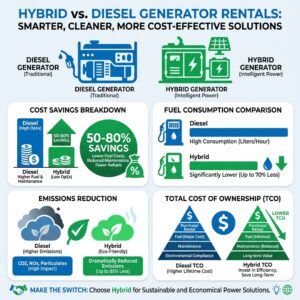
Standard diesel generators are the industry baseline. Hybrid generators, which combine a diesel engine with a battery energy storage system (BESS) — can reduce engine runtime by up to 90% according to Atlas Copco, significantly cutting fuel consumption over the life of a project. On long-duration projects, a hybrid generator rental can deliver meaningful savings versus a diesel-only unit.
5. Location and Delivery Distance
Texas is a large state. Generator rental pricing in Austin, Dallas, San Antonio, Fort Worth, and Waco will vary slightly based on delivery distance, local demand, and site access. Projects in remote areas — oil fields, rural infrastructure, or sites far from urban centers — may carry higher delivery costs than central city job sites.
Generator Rental Cost by Project Type
Different industries have different power requirements, and that shapes what they pay.
| Project Type | Typical KW Need | Key Cost Drivers |
|---|---|---|
| Residential construction trailer | 20–45 KW | Low draw; short runs; seasonal |
| Commercial construction (multi-trailer) | 60–150 KW | 24/7 operation; multiple loads |
| Large commercial or infrastructure project | 150–500 KW | Continuous prime power; fuel volume |
| Oil & gas remote site | 60–200 KW | Remote delivery; extended duration |
| Temporary medical facility | 45–100 KW | Mission-critical uptime; redundancy |
| Portable classroom / education | 20–60 KW | Seasonal use; multiple units |
| Outdoor event (commercial) | 60–250 KW | Short-term; high peak demand |
Key Takeaway: Construction and oil & gas projects are typically the heaviest generator users — not just in KW demand but in operating hours. These projects benefit most from all-inclusive flat-rate pricing because their fuel and maintenance costs are highest.
What Should Be Included in Your Generator Rental Agreement?
Before signing any rental agreement in Texas, confirm these items are covered at no additional charge:
- Delivery to job site
- Installation and electrical hookup
- All required cabling and distribution boxes
- Fuel delivery and ongoing fuel management
- Preventive maintenance visits
- Oil changes
- Remote monitoring and uptime management
- Emergency response if equipment goes down
- Pickup at project completion
If any of these are listed as separate line items on a quote, your actual monthly cost will be higher than the base rate shown. A 200 KW generator rental that appears affordable at first glance can carry significant add-on costs once fuel delivery and maintenance are billed separately.
Compliance Costs: Tier 4 Emissions in Texas
Texas construction projects operating off-grid must use generators that comply with EPA Tier 4 Final emissions standards. The EPA’s Tier 4 program applies to nonroad compression-ignition (diesel) engines — including generators, pumps, and compressors used on construction sites.
Tier 4 Final generators require advanced emissions control systems that significantly reduce particulate matter and nitrogen oxides compared to older equipment. Renting non-compliant equipment on a Texas job site can expose your project to regulatory risk.
All JC Davis Power generators meet Tier 4 emissions requirements, and our team handles compliance documentation so you don’t have to manage it.
Additionally, OSHA 29 CFR 1926 Subpart K governs temporary electrical power on construction sites, including requirements for equipment approval, grounding, and safe proximity to electrical circuits. A professionally managed generator rental that includes installation and monitoring ensures your site stays compliant with both EPA and OSHA requirements.
Flat-Rate Pricing vs. Per-Item Billing: A Real Cost Comparison
Here is how two different pricing models play out over a 6-month construction project requiring a mid-size generator:
| Cost Item | Line-Item Billing Model | Flat-Rate Model (JC Davis) |
|---|---|---|
| Generator unit rental | Billed monthly | Included |
| Fuel delivery (monthly) | Additional charge | Included |
| Preventive maintenance visits | Per-visit charge | Included |
| Oil changes | Additional charge | Included |
| Remote monitoring | Additional charge | Included |
| Delivery to site | One-time charge | Included |
| Pickup at project end | One-time charge | Included |
| Total cost predictability | Variable — increases with runtime | Fixed — same every month |
For project managers working with fixed budgets, uncontrolled variable charges are a real risk. A project running 24/7 through a Texas summer — where generators work harder in extreme heat — can see fuel costs spike unpredictably with a per-item billing model.
Key Takeaway: The real cost of generator rental isn’t the base rate — it’s the base rate plus every line item your vendor adds. A flat-rate all-inclusive model is the only way to lock in true cost control for the full project duration.

Hybrid vs. Diesel Generator Rental: The Cost Difference
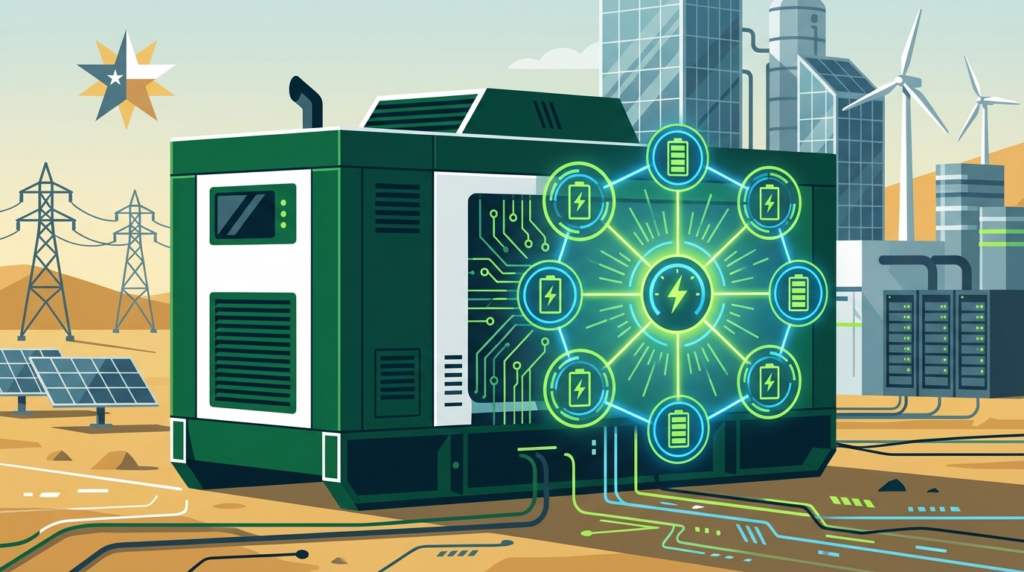
Hybrid generators combine a diesel engine with a lithium-ion battery storage system. The intelligent controller only activates the diesel engine when battery charge drops below a threshold or demand spikes — meaning the engine runs a fraction of the hours a standard diesel unit would.
According to Atlas Copco, this can reduce fuel consumption by up to 90% and cut engine runtime dramatically. For a long-duration project, fewer engine hours also mean lower maintenance costs and extended equipment life.
JC Davis Power offers hybrid generator rentals for Texas projects where noise reduction, fuel efficiency, or lower carbon footprint are priorities — including residential construction near occupied neighborhoods, medical facility operations, and large-scale commercial projects with sustainability requirements.
How to Get an Accurate Generator Rental Quote in Texas
Before calling any rental company, have these details ready:
- Project location — city/site address for delivery logistics
- Project duration — start and estimated end date
- Power requirements — what equipment will be running simultaneously (HVAC, lights, computers, tools)
- Operating schedule — 8-hour, 16-hour, or 24/7 operation
- Site access — any restrictions on delivery vehicle size or placement
With these five data points, a reputable generator rental company can provide an accurate flat-rate quote rather than an estimate that changes at billing time.
JC Davis Power serves Austin, Dallas, Fort Worth, San Antonio, Waco, and surrounding Texas regions. Our team assesses your site requirements and provides a single monthly rate — no surprises. Contact us to get a quote for your project.
FAQ: Generator Rental Cost in Texas
How much does it cost to rent a generator in Texas?
Generator rental costs in Texas vary based on KW size, project duration, and what’s included in the agreement. Small generators for construction trailers start at lower monthly rates, while large industrial generators for multi-trailer sites or oil field operations carry higher rates. The most important factor is whether the quote includes fuel, maintenance, and monitoring — or bills those separately. An all-inclusive flat-rate agreement from JC Davis Power gives you one predictable number for the full project.
What’s the difference between a daily and monthly generator rental rate?
Most industrial generator rentals for construction and oil & gas projects are structured as monthly agreements rather than daily rentals. Monthly flat-rate pricing is more cost-effective for projects lasting more than a few weeks and eliminates the billing complexity of per-day or per-hour charges. Our mobile office power generation service is priced on a monthly all-inclusive basis.
Does generator rental include fuel in Texas?
It depends on the vendor. Some companies charge for fuel separately as a variable cost that changes based on runtime and diesel prices. JC Davis Power includes fuel management in our flat monthly rate — we handle delivery and refueling at no additional charge throughout your project.
Do I need a Tier 4 compliant generator for my Texas job site?
If you are using a generator as your primary power source on a construction site, EPA Tier 4 Final standards apply to nonroad diesel engines including generators. All JC Davis Power equipment meets Tier 4 compliance requirements.
What generator size do I need for a construction site?
Size depends on the total electrical load — what equipment will be running simultaneously. A single construction trailer with HVAC, lighting, and office equipment typically requires 20–45 KW. Multi-trailer sites or sites with high-draw tools and equipment may need 100–200 KW or more. JC Davis Power can assess your site and recommend the right size. Visit our lighting towers page if you also need job site illumination alongside your generator rental.
External Sources
- EPA: Regulations for Emissions from Heavy Equipment with Compression-Ignition (Diesel) Engines
- OSHA 1926.416 — General Electrical Requirements for Construction Sites
- Atlas Copco: How Hybrid Generators Are Reshaping Off-Grid Energy Access