Most project managers renting generators in Texas default to diesel — it’s familiar, reliable, and available everywhere. But hybrid generator rental has crossed from niche technology into a practical option, especially for Texas projects where noise restrictions, sustainability requirements, or long-duration fuel costs are a concern.
This guide explains exactly what a hybrid generator is, how it performs differently from a standard diesel unit, and which types of Texas job sites get the most value from renting one.
In this article:
- What a hybrid generator is and how it works
- How hybrid compares to diesel for fuel consumption and noise
- Which job sites and industries benefit most from hybrid work
- EPA Tier 4 compliance and how hybrid fits in
- Hybrid generator rental vs. diesel rental: side-by-side comparison
- When to choose diesel instead
- FAQ: Hybrid generator rental in Texas
What Is a Hybrid Generator?
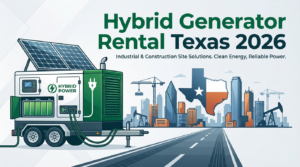
A hybrid generator combines three components: a diesel engine, a lithium-ion battery energy storage system (BESS), and an intelligent controller that manages when each power source activates.
The key difference from a standard diesel generator: the engine does not run continuously. Instead, the system works in two modes:
- Battery mode — The system powers your site silently from the battery bank during low-to-moderate demand periods
- Engine mode — The diesel engine activates only when battery charge drops below a set threshold, demand spikes above battery capacity, or the batteries need recharging
The result is a generator that behaves like a standard unit from the user’s perspective — reliable, available power at all times — but with the diesel engine running a fraction of the total hours.
Key Takeaway: A hybrid generator is not a different product category — it is a diesel generator with an intelligent battery system layered on top. The diesel engine is still there as the backbone. The difference is how often it runs.
How Much Fuel Does a Hybrid Generator Save?
This is the core reason projects switch from diesel to hybrid. According to Atlas Copco, smart switching between battery and engine power can reduce fuel consumption by up to 90% compared to a continuously running diesel unit.
In practice, savings vary based on your load profile:
| Load Pattern | Diesel Engine Behavior | Typical Fuel Reduction |
|---|---|---|
| Steady high load (24/7 heavy equipment) | Engine runs frequently | 20–40% reduction |
| Variable load (office trailers, HVAC cycling) | Engine runs in bursts | 50–70% reduction |
| Low-to-moderate load (nights, weekends, partial site activity) | Battery handles most demand | 70–90% reduction |
Construction sites with variable loads — a trailer running HVAC, lighting, and office equipment during business hours but drawing minimal power overnight — are the strongest candidates for hybrid rental.
Key Takeaway: The more your power demand varies throughout the day, the more fuel a hybrid generator saves. Sites with consistent 24/7 heavy loads see smaller gains; sites with cycling demand see the largest savings.
Noise Reduction: Why It Matters on Texas Job Sites
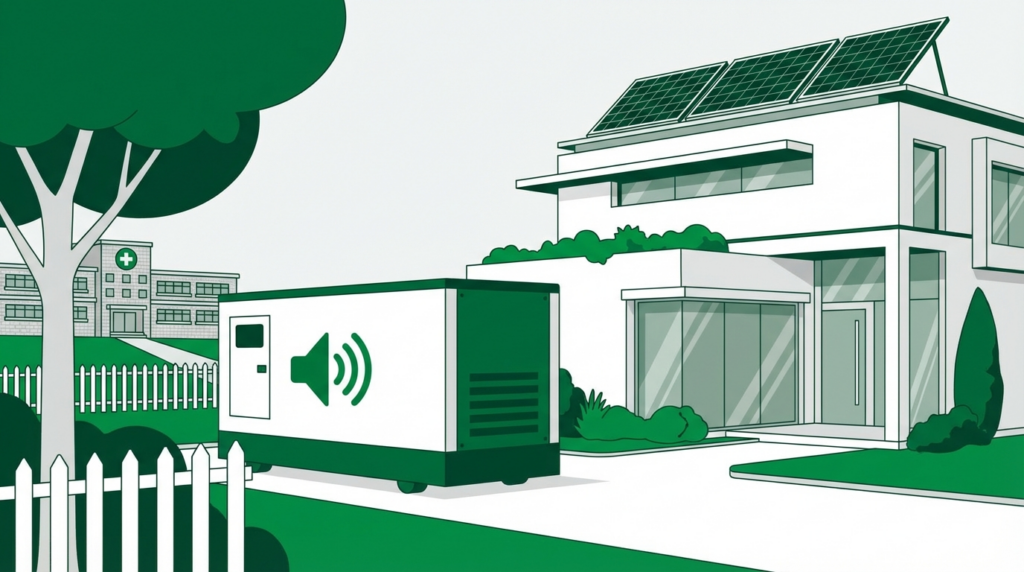
A diesel generator running at full capacity produces significant noise. In urban construction zones, near residential areas, or on hospital and school campuses, that noise creates friction with neighbors, regulatory pressure, and sometimes contractual restrictions.
A hybrid generator running in battery mode is nearly silent. The diesel engine only activates when needed, which on a variable-load site may mean it runs only a few hours per day, leaving the rest of the operating period quiet.
Texas job site applications where noise reduction matters most:
- Residential construction in established neighborhoods (Austin, Dallas suburbs, San Antonio)
- Hospital or medical campus construction — noise-sensitive environments with patients nearby
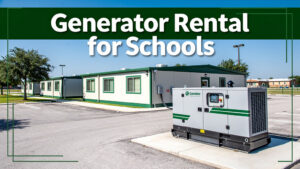
- School campus work where active classes may be running adjacent to construction
- Downtown or infill commercial construction with neighboring occupied buildings
- Outdoor events where generator noise affects the experience
Hybrid Generators and EPA Tier 4 Compliance
All nonroad diesel engines used in prime power applications, including generators on Texas construction sites — must comply with EPA Tier 4 Final emissions standards under 40 CFR Part 1039. Tier 4 Final standards govern particulate matter and nitrogen oxide emissions from diesel engines.
Hybrid generators meet Tier 4 requirements through their diesel engine component. Additionally, because the diesel engine runs fewer hours in a hybrid system, real-world emissions per project are lower than a compliant diesel unit running continuously — even though both meet the same regulatory threshold.
For Texas projects where local air quality management districts have additional restrictions beyond federal standards, fewer engine runtime hours provide a practical compliance buffer.
All JC Davis Power hybrid generators are Tier 4 Final compliant.
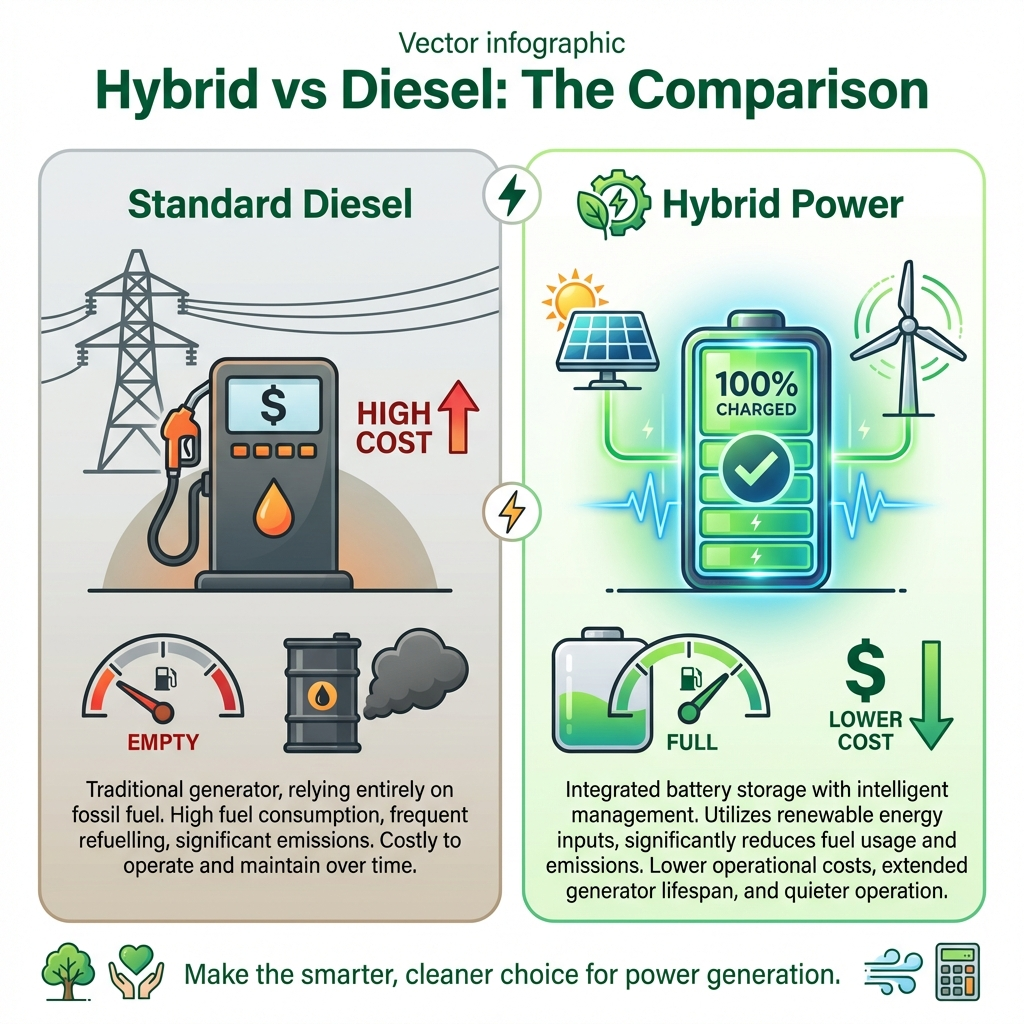
Hybrid vs. Diesel Generator Rental: Side-by-Side Comparison
| Factor | Standard Diesel Rental | Hybrid Generator Rental |
|---|---|---|
| Engine operation | Continuous | On-demand (battery fills gaps) |
| Fuel consumption | Higher — engine runs at all times | Lower — engine activates as needed |
| Noise level | Constant diesel engine noise | Quiet during battery-only operation |
| EPA Tier 4 compliance | Yes | Yes |
| Maintenance intervals | Standard | Extended — fewer engine hours = less wear |
| Best for | Consistent heavy loads, remote sites, high-runtime operations | Variable-load sites, noise-sensitive environments, sustainability requirements |
| Available from JC Davis Power | Yes | Yes |
Key Takeaway: There is no universally better option between diesel and hybrid — the right choice depends on your load profile, site environment, and project duration. Both are Tier 4 compliant. Hybrid wins on fuel cost and noise; diesel wins on simplicity and peak-load reliability.
Which Texas Job Sites Are Best Suited for Hybrid Generator Rental?
Construction Projects in Urban or Suburban Areas
Projects in Austin’s central neighborhoods, Dallas-Fort Worth suburbs, or San Antonio’s residential zones often face noise ordinances or neighbor pressure. A hybrid unit running silently on battery for most of the day — with the engine only activating during peak load periods — reduces that friction significantly.
Long-Duration Projects with Variable Loads
The longer a project runs and the more variable its power demand, the more a hybrid unit pays off in reduced fuel consumption. A 12-month construction project with mobile office trailers cycling HVAC on and off throughout the day is a strong hybrid candidate.
Medical and Healthcare Facilities
Temporary medical facilities — drive-through testing sites, mobile clinics, or construction adjacent to active patient areas — benefit from both the noise reduction and the consistent uptime that hybrid systems provide. Our mobile office power generation solutions are available in hybrid configurations for exactly these environments.
Sustainability-Committed Projects
Major Texas contractors working with clients who track carbon metrics or have sustainability reporting requirements benefit from the lower emissions profile of hybrid operation. Fewer engine hours mean less fuel burned and fewer emissions over the project lifecycle.
When to Choose Diesel Instead of Hybrid
Hybrid is not the right fit for every project. Choose a standard diesel generator when:
- Your load is consistently high — if you’re running heavy industrial equipment at or near full capacity 24/7, the battery system has little opportunity to offset engine runtime, reducing its advantage
- You’re on a remote site with no noise constraints — oil field operations, highway projects in open terrain, or rural builds where noise is not a factor get less benefit from battery-mode quiet
- Project duration is short — for deployments of a few weeks, the fuel savings may not justify any rate differential
- Simplicity is the priority — diesel generators have a longer operational track record and are the most familiar technology for site crews
Our generator rental services include both diesel and hybrid options. Our team can assess your project load requirements and recommend the right configuration.
How to Rent a Hybrid Generator in Texas
JC Davis Power rents hybrid generators across Texas — Austin, Dallas, Fort Worth, San Antonio, Waco, and surrounding regions. The rental process is the same as any generator rental:
- Share your project details — location, duration, and load requirements
- We assess the right configuration — hybrid or diesel, sized correctly for your site
- Delivery and installation — our team handles hookup, cabling, and commissioning
- Ongoing management — remote monitoring, fuel management, and maintenance are included in your flat monthly rate
- Pickup at project completion — included at no charge
There are no hidden fees for fuel, maintenance, or monitoring regardless of which generator type you rent. Contact JC Davis Power to discuss hybrid generator rental for your Texas project.
FAQ: Hybrid Generator Rental in Texas
What is a hybrid generator and how is it different from diesel?
A hybrid generator pairs a diesel engine with a lithium-ion battery storage system. An intelligent controller decides when to run the diesel engine and when to operate from battery power. The diesel engine activates on demand rather than running continuously, which reduces fuel consumption and noise compared to a standard diesel unit. Atlas Copco reports that this approach can reduce fuel consumption by up to 90% on variable-load applications.
Is a hybrid generator more expensive to rent than diesel?
Rental rates for hybrid generators reflect the added technology of the battery storage system. However, for projects with variable load profiles, the reduction in fuel consumption over the project duration typically offsets any rate difference. On all-inclusive flat-rate contracts, JC Davis Power handles fuel regardless of consumption — contact us to discuss the right configuration for your project’s budget.
Are hybrid generators Tier 4 compliant for Texas construction sites?
Yes. Hybrid generators use a diesel engine as their primary power source, and that engine meets EPA Tier 4 Final emissions standards — the same requirement as standard diesel generators used for prime power on construction sites.
Can a hybrid generator power a full construction site?
Yes. Hybrid generators are sized the same way as diesel units — by KW output — and can support the same loads. The hybrid technology operates behind the scenes; from a load perspective, your site gets the same reliable power. The difference is in how the system delivers that power and how efficiently it uses fuel.
Does JC Davis Power offer hybrid generator rental in San Antonio and Dallas?
Yes. JC Davis Power offers hybrid generator rental across all our Texas service areas, including generator rental in San Antonio, generator rental in Dallas, Austin, Fort Worth, and Waco. Contact us to confirm availability for your project location.