
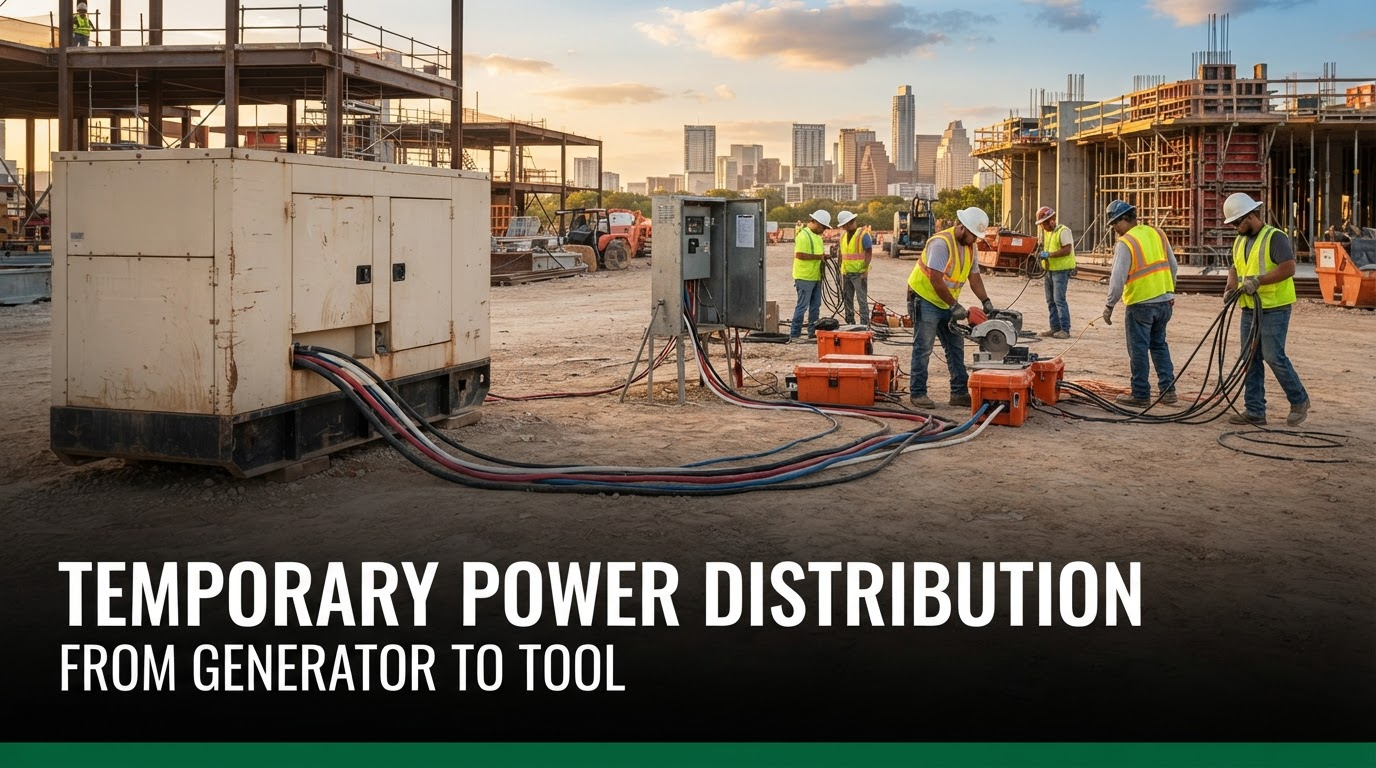
Temporary power distribution is the chain of equipment that takes generator output and splits it safely into usable circuits across a job site. It runs from the genset through cam-lock feeder cables to a distribution panel, then to spider boxes and cord sets at the point of work.
Key Takeaways
- The generator is only the first link. Most job site power problems are distribution problems, not generator problems.
- Cam-lock connectors are the standard for feeder cable between the generator and the distribution panel. They are color-coded by conductor, and getting the sequence right matters.
- Spider boxes are the endpoint. They carry GFCI-protected receptacles and breakers where crews actually plug in.
- OSHA requires GFCI protection on all 120-volt, 15- and 20-ampere construction receptacles, and prohibits laying branch-circuit conductors on the floor.
- Voltage drop over long cable runs is the most common reason a correctly sized generator still browns out a tool.
- Temporary wiring must be removed as soon as the work it was installed for is finished.
The Chain, Link by Link
Picture a Texas job site with a 200 kW unit parked at the perimeter and crews working 300 feet away. Nothing about the generator determines whether those crews have power. Five things between the two do.
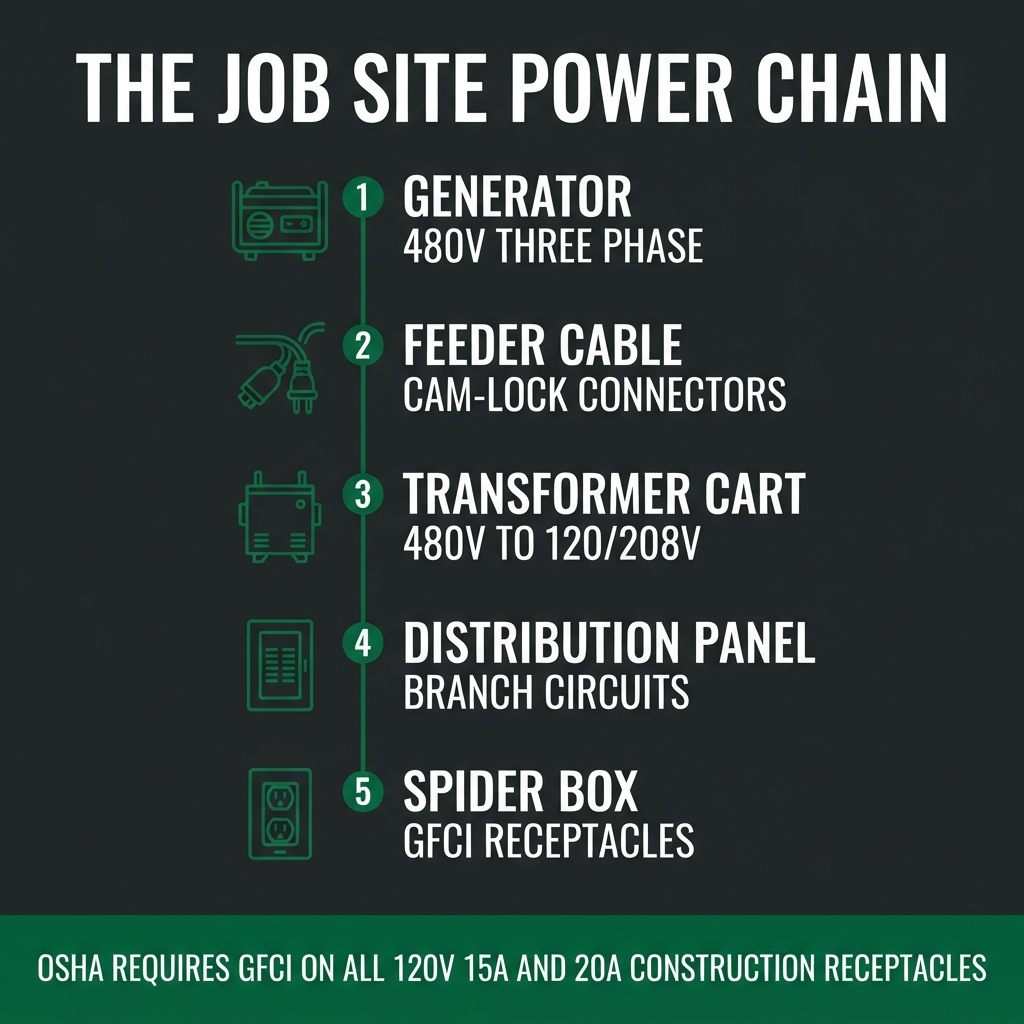
1. The generator output
Most mid-size and large rental units put out 480V three-phase, which is efficient to move over distance but not what a circular saw wants. This is why distribution starts with a decision about whether you need a transformer in the chain.
2. Feeder cable and cam-lock connectors
Feeder cable carries the load from the generator to the distribution point. On rental equipment the terminations are usually cam-lock connectors, single-pole devices that mate one conductor at a time and are color-coded so the phase, neutral, and ground sequence stays consistent.
The color-coding exists because connecting single-pole devices one at a time makes it possible to get it wrong in a way that a multi-pole plug does not. This is qualified-person work, not an anyone-can-do-it task.
3. Distribution panel or transformer cart
This is where the chain either steps voltage down, splits into branch circuits, or both. A transformer cart takes 480V and delivers 120/208V. A distribution panel breaks the incoming feed into protected branch circuits.
OSHA is specific here. Under 1926.405(a)(2)(ii)(A), feeders must originate in a distribution center, and branch circuits under (B) must originate in a power outlet or panelboard.
4. Spider boxes
A spider box is a portable enclosure with multiple GFCI-protected receptacles and its own breakers, fed by a single cord from the panel. It is the thing that turns one circuit into six working outlets at the point of use, and it is what keeps crews from daisy-chaining extension cords across a slab.
5. Cord sets
The last link, and the one most likely to be damaged. OSHA requires under 1926.405(a)(2)(ii)(I) that flexible cords be protected from damage, and (B) states plainly that no branch-circuit conductors shall be laid on the floor.
What Each Component Does
| Component | Function | Typical position | What goes wrong |
|---|---|---|---|
| Feeder cable | Carries bulk load from generator | Generator to panel | Undersized for distance, voltage drop |
| Cam-lock connectors | Terminates feeder conductors | Both ends of feeder | Wrong sequence, damaged boots, unqualified handling |
| Transformer cart | Steps 480V down to 120/208V | Between feeder and panel | Omitted from the plan entirely |
| Distribution panel | Splits feed into protected branch circuits | Central to the work area | Placed too far from where crews work |
| Spider box | Multiple GFCI receptacles at point of use | Work areas | Too few of them, so crews run long cords |
| Cord sets | Final connection to tools | Spider box to tool | Laid on the floor, damaged, not tested |
Voltage Drop: The Failure Nobody Sizes For
Here is the scenario that generates the most confused phone calls. The generator is correctly sized. The load calculation was right. And crews at the far end of the site are tripping breakers and burning out motors.
The cause is almost always voltage drop across a long undersized cable run. Voltage falls with distance and rises with load, and a motor fed at low voltage draws more current to compensate, which heats it and eventually kills it.
Two practical responses. Either upsize the feeder conductor for the run, or move the distribution point closer to the work and accept a longer high-voltage run instead of a long low-voltage one. Moving 480V 300 feet and stepping it down locally is far more efficient than moving 120V the same distance.
If you are still working out the generator side of this, our generator sizing guide covers the load math, and the kVA to kW conversion guide explains how to read what the spec sheet is actually telling you.
The Code Requirements That Get Cited
Temporary distribution has a short list of rules that account for most of what inspectors write up.
GFCI protection. All 120-volt, single-phase, 15- and 20-ampere receptacle outlets on construction sites that are not part of the permanent wiring and are in use by employees must have approved ground-fault circuit interrupters, under 1926.404(b)(1)(ii). There is a narrow exception for two-wire, single-phase portable or vehicle-mounted generators rated not more than 5 kW where the circuit conductors are insulated from the frame.
The alternative program. If a contractor uses an assured equipment grounding conductor program instead, 1926.404(b)(1)(iii) requires testing before first use, after repairs, after suspected damage, and at intervals not exceeding 3 months, or 6 months for fixed cord sets and receptacles not exposed to damage.
Support and routing. Open conductors must be fastened at intervals not exceeding 10 feet, and branch-circuit conductors may not be laid on the floor, per 1926.405(a)(2)(ii).
Duration. Temporary wiring must be removed immediately upon completion of construction or the purpose for which it was installed, under 1926.405(a)(2)(i).
High voltage. Temporary wiring over 600 volts requires fencing, barriers, or other effective means limiting access to qualified persons, under 1926.405(a)(2)(iii).
OSHA’s electrical incidents eTool lists the most frequent causes of electrical injury in construction as contact with power lines, lack of ground-fault protection, missing or discontinuous grounding paths, equipment misuse, and improper extension and flexible cord usage. Four of those five are distribution failures rather than generator failures.
Five Mistakes We See on Texas Sites
- Sizing the generator and stopping there. The distribution plan gets improvised on mobilization day.
- One distribution point for a long site. Cheap up front, expensive in cord damage and voltage complaints.
- Too few spider boxes. Crews solve the shortage with daisy-chained cords, which is exactly the hazard the boxes exist to prevent.
- Cords on the ground in traffic lanes. Texas summer heat plus vehicle traffic plus standing water after an afternoon storm is a bad combination for a cord jacket.
- Leaving the temporary installation up past its purpose. Once the permanent service is live, the temporary wiring is a liability with no upside.
Getting the Distribution Plan Right
The generator is the part everyone thinks about, and it is the part least likely to cause trouble. The distribution chain is where the real planning pays, because it determines whether power is actually available where crews are standing, whether it holds voltage under load, and whether an inspector finds anything to write down.
We handle the full chain on job sites across Austin, Dallas, San Antonio, Fort Worth, and Waco, from temporary generator power through delivery, setup, and the distribution gear that goes with it. If you are planning a site and want the layout worked out before mobilization rather than after, contact us and we will map it with you. It is also worth reading our guide to generator hookup and wiring requirements and the piece on choosing between automatic and manual transfer switches if a connection to existing building service is part of your plan.
Frequently Asked Questions
How does a temporary power distribution box work?
A distribution box takes a single incoming feed, usually from a generator or temporary utility drop, and splits it into multiple protected branch circuits. Internal breakers provide overcurrent protection for each circuit, and GFCI devices protect personnel. The box gives crews multiple safe connection points from one supply.
How long can you run temporary power?
There is no fixed hour limit, but OSHA requires that temporary wiring be removed immediately upon completion of construction or the purpose for which it was installed. In practice, temporary power runs for the duration of the project, from mobilization until permanent service is energized and accepted.
How much does temporary power cost?
Cost depends on generator size, rental duration, how much distribution equipment the layout needs, and whether fuel and service are included. Distribution gear is usually a modest fraction of the total against the genset and fuel. Our Texas generator rental cost guide breaks down what drives the number.
What are the three types of power distribution?
In a temporary job site context, the practical distinction is between radial distribution from a single central point, distributed layouts with multiple panels serving separate zones, and stepped-down distribution where a transformer converts higher-voltage feeder power to usable 120/208V near the work. Most large sites end up using a combination.