
Key Takeaways
- Nearly 1 in 3 U.S. public schools uses at least one portable building on campus, and those structures need a reliable power source to function safely.
- A standard portable classroom running HVAC, lighting, computers, and a projector typically draws 3–6 kW of continuous load, requiring a 10–20 kW generator for safe overhead capacity.
- Texas public schools enrolled 5,544,255 students in 2024–25, with enrollment growing every year since 1987, portable classrooms are a permanent fixture of that growth strategy.
- OSHA regulation 1926.56 sets a minimum of 5 foot-candles for occupied indoor spaces; portable classroom generators must support consistent lighting at that standard.
- Managed generator rental, where fuel, maintenance, and delivery are handled for you, removes the burden from your facilities team and keeps classrooms compliant year-round.
- An industrial generator rental for school use is not a construction job; it’s an educational infrastructure decision that affects students, staff, and district liability.
Powering a portable classroom sounds simple. It isn’t. You’ve got HVAC loads, classroom lighting, computer labs, projectors, and sometimes medical equipment, all running off a single temporary power connection that needs to be safe, code-compliant, and rock-solid every school day.
We work with schools, districts, and educational facilities across Texas that face exactly this situation. Here’s what you need to know before you rent a generator for your campus.
Why Schools Are Turning to Generator Rental for Portable Classrooms
Portable classrooms, also called relocatable classrooms or modular classroom units, are a standard tool for managing enrollment growth. According to the National Center for Education Statistics, nearly 31% of public schools now operate at least one non-permanent building on campus.
That number isn’t surprising in Texas. The Texas Education Agency reports statewide enrollment has grown every year since 1987–88, often by 1–3% annually. When a district adds 400 students, it can’t always wait two years for a new wing. It puts up portable classrooms within months.
But portable classrooms don’t always have direct utility tie-ins. Some campuses lack the electrical infrastructure to extend permanent power to every new structure. Others face permit delays, utility installation backlogs, or budget freezes that stall the permanent solution. In every one of those situations, a temporary diesel generator rental fills the gap, and fills it fast.
Our mobile office power generation service is purpose-built for exactly this scenario: conditioned, occupied structures that need real, sustained power, not just a jobsite workaround.
Key takeaway: Portable classroom power gaps are a predictable part of school growth, and generator rental is the standard fix while permanent infrastructure catches up.
How Much Power Does a Portable Classroom Actually Need?
A portable classroom is a load-dense environment. The HVAC system alone can pull 2–4 kW. Add lighting, computers, a projector, a printer, and a coffee maker in the teacher’s lounge, and you’re looking at real amperage requirements.
Here’s a practical reference table for facilities planners and district operations managers:
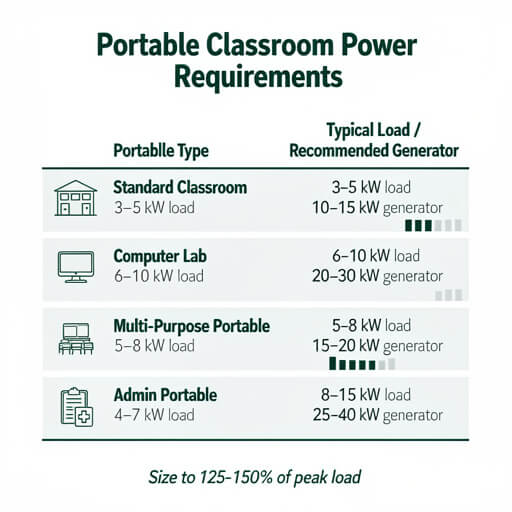
| Classroom Type | Typical Continuous Load | Recommended Generator Size |
|---|---|---|
| Standard classroom (lighting + HVAC + 10 devices) | 3–5 kW | 10–15 kW |
| Computer lab (20–30 workstations + HVAC) | 6–10 kW | 20–30 kW |
| Multi-purpose portable (AV + HVAC + lighting) | 5–8 kW | 15–25 kW |
| Admin/office portable (phones, computers, copiers) | 4–7 kW | 15–20 kW |
| Medical or clinic portable (powered equipment) | 8–15 kW | 25–40 kW |
These are conservative figures using a standard 1.25–1.5x load multiplier for safe operating overhead. A diesel generator running at 80% capacity lasts longer and runs more efficiently than one pushed to its limit. That’s why sizing up matters, especially in Texas summers when AC units run hard from 7 AM to 6 PM.
For multi-classroom setups, we evaluate total campus load and can design a temporary power rental solution that feeds multiple structures from a single larger unit, which is often more cost-effective than deploying individual generators per building.
Key takeaway: Size your generator at 125–150% of your expected peak load. For a standard portable classroom with AC and computers, a 15–20 kW unit is the right starting point.
The Power Challenges Schools Face That Most Providers Don’t Plan For
School power isn’t construction power. The demands are different, and the stakes are higher.
Consistent daily cycles. A jobsite generator runs hard for a few weeks and moves on. A school generator runs Monday through Friday, often 180+ days a year. Fuel management and scheduled maintenance aren’t optional, they’re what keep class in session.
Safety and compliance. OSHA’s illumination standard (29 CFR 1926.56) requires a minimum of 5 foot-candles in occupied indoor areas. Temporary electrical installations must also comply with NEC Article 590, which governs ground-fault protection and overcurrent requirements for any power derived from an on-site generator. Getting this wrong isn’t just a compliance issue, it’s a liability issue for the district.
Temperature extremes in Texas. Austin, Dallas, San Antonio, and Fort Worth all see prolonged heat events above 100°F. An undersized or poorly maintained generator that trips offline in August doesn’t just inconvenience staff, it sends students home and disrupts the school day.
Noise ordinances. Generators near occupied classrooms need to meet local noise standards. Modern standby generators and properly placed diesel units can run at acceptable decibel levels, but placement and enclosure matter.
Our team handles all of this in advance. Before delivery, we assess your campus layout, confirm local code requirements, and match the right equipment to your specific load profile. Read about how we approach the versatility of mobile office power solutions for contexts that demand this level of planning, from healthcare to education.
Key takeaway: School power challenges are ongoing, not one-time. Compliance with OSHA illumination standards and NEC Article 590 is non-negotiable for any occupied classroom.
What to Look for in a School Generator Rental Provider
Not every generator company is set up for a school environment. Here’s what separates a provider who can handle a campus from one who can’t.
All-inclusive service. Fuel delivery, preventive maintenance, and emergency response should all be included in your rental agreement. Your facilities team shouldn’t be responsible for checking oil levels or calling for a fuel top-off.
Managed delivery and setup. A reputable provider handles permitting support, proper grounding, and load connection, not just dropping a unit in the parking lot and handing you a key.
Response time guarantees. If your generator goes down at 6 AM before the school day starts, you need someone on-site fast. Ask what the guaranteed response time is, and get it in writing.
Equipment that matches educational loads. Generators designed for construction trailer power are built for continuous, rugged service, the same durability profile a school year demands, just in a quieter, more controlled environment.
Texas-based availability. If you’re in Austin, Dallas, Fort Worth, San Antonio, or Waco, local availability means faster delivery and faster response. We serve all of these markets. Check availability for generator rental in Austin or generator rental in Dallas based on your location.
Key takeaway: The right provider handles fuel, maintenance, and compliance, not just equipment delivery. For a school, anything less creates operational risk.
Managed Power vs. Self-Managed: What’s Right for Your School?
Some districts try to manage generator rentals themselves, renting bare equipment and assigning fuel and maintenance to their facilities staff. It works, sometimes. But the real-world friction adds up fast.
| Factor | Managed Service | Self-Managed Rental |
|---|---|---|
| Fuel delivery | Included, scheduled | District arranges separately |
| Preventive maintenance | Included | District coordinates with vendor |
| Emergency response | Provider handles | District calls in, waits |
| Compliance documentation | Provider manages | District responsibility |
| Cost predictability | Fixed monthly cost | Variable (fuel, repairs, labor) |
| Facilities staff burden | Minimal | High |
For most K–12 districts, the managed model is the better choice. School facilities directors are already managing construction projects, deferred maintenance backlogs, and daily operations. Adding generator management to that list introduces failure points that don’t need to exist.
We structure our education sector engagements as fully managed rentals, your team doesn’t need to think about the generator. It’s just there, running, every school day.
Key takeaway: Managed power costs more per month than bare-equipment rental, but it eliminates the labor, liability, and downtime risks that make self-managed generator programs fail.
Planning Your School’s Temporary Power: A Step-by-Step Checklist
Use this checklist when planning generator power for a portable classroom installation or campus expansion project.
Before you call a provider:
- Count the number of portable structures needing power
- Document HVAC equipment model and wattage for each structure
- Estimate number of devices (computers, projectors, printers) per room
- Identify any special loads (medical equipment, servers, kitchen appliances)
- Check local permit requirements for temporary electrical installations
- Confirm campus layout for generator placement (noise, access, safety setbacks)
When evaluating providers:
- Ask for a load calculation, not just a unit recommendation
- Confirm fuel delivery and maintenance are included
- Verify response time guarantees in writing
- Ask about maximizing generator efficiency and runtime to understand long-term operating costs
- Confirm NEC Article 590 and local code compliance is part of their setup process
Before the school year starts:
- Schedule a test run at least one week before the first day of classes
- Brief your facilities team on emergency shutdown procedures
- Confirm fuel levels are topped off for day one
Ready to get your portable classrooms powered before the next school year? Contact JC Davis Power for a campus power consultation, we’ll assess your load, walk your site, and put together a managed rental plan that keeps class in session all year. Or learn more about our mobile office power generation service to see exactly what’s included.
Frequently Asked Questions
Q: How much does it cost to rent a generator for a portable classroom in Texas?
A: Generator rental for a single portable classroom typically runs $400–$900 per month for a 15–20 kW managed unit, including fuel and maintenance. Multi-classroom setups using a shared 40–60 kW unit may cost $800–$1,800 per month depending on load and service level. Get a site-specific quote before budgeting, load profiles vary significantly by classroom type and HVAC equipment.
Q: What size generator does a portable classroom need?
A: Most standard portable classrooms, with lighting, HVAC, and 10–15 computers, need a 10–20 kW generator for safe operation. Size to 125–150% of your peak expected load, not your average load. In Texas summers, AC systems run continuously during school hours, so peak and average loads are often the same.
Q: Can a school use industrial generator rental for permanent power needs?
A: An industrial generator rental is designed for temporary power, typically covering the period while permanent utility connections are installed or upgraded. NEC Article 590 governs temporary electrical installations and specifies they must be removed when the permanent power source is available. For extended coverage (1–3 years), a long-term managed rental is structurally the same as a temporary one, but the service agreement reflects the longer timeline.
Q: Does a portable classroom generator need special permits in Texas?
A: Yes, in most Texas jurisdictions. Temporary electrical installations for occupied structures, including portable classrooms, require a permit and must comply with NEC Article 590, including ground-fault protection and proper overcurrent devices. Your generator provider should be familiar with local requirements and can often assist with permit documentation as part of a managed service.
Sources
- National Center for Education Statistics — Nearly One-Third of Public Schools Have One or More Portable Buildings in Use
- Texas Education Agency — Enrollment Trends in Texas Public Schools
- OSHA — 29 CFR 1926.56: Illumination Standards for Construction
- EC&M — The Apprentice’s Guide to NEC Article 590: Temporary Installations